Production Conveyor Systems for Scalable Manufacturing: The Invisible Force behind Smart Factory Automation
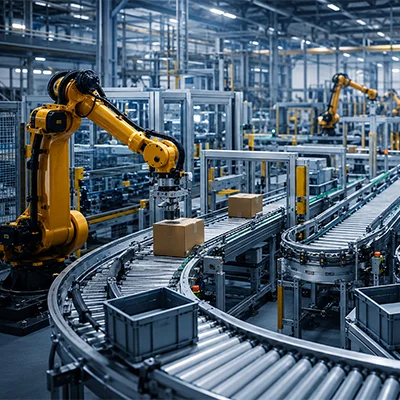
Modern manufacturing is often associated with robots, AI-powered quality inspection, predictive maintenance, and digital twins. Yet behind every successful smart factory lies a technology that rarely makes headlines—but determines whether production scales efficiently or struggles under pressure: Production Conveyor Systems.
Think of a factory as a living organism. Machines act as the muscles, software as the brain, operators as the decision-makers, but conveyors? They're the circulatory system that keeps everything moving. No matter how advanced production equipment becomes, materials that fail to arrive at the right place, at the right time, create bottlenecks that ripple across the entire manufacturing ecosystem.
Today's manufacturers aren't simply purchasing conveyors to move products from Point A to Point B. They're investing in intelligent, connected, and highly adaptable systems that actively contribute to productivity, operational resilience, and future scalability.
As global supply chains become increasingly dynamic and customer expectations continue to evolve, the role of Industrial Conveyor Systems has shifted from passive infrastructure to strategic business enablers. The question is no longer whether a conveyor can transport products—but whether it can support a factory designed to evolve over the next decade.
Manufacturing Is No Longer Built for Today's Demand
For decades, factories were designed around predictable production schedules. A production line manufactured one product, in one configuration, for extended periods.
That model has largely disappeared.
Manufacturers today face:
- Frequent product changeovers
- Shorter product life cycles
- Increasing customization
- Growing labor shortages
- Rising production costs
- Pressure to improve sustainability
- Demand for real-time production visibility
Adding more machines alone doesn't solve these challenges.
The real bottleneck often lies between machines—where materials wait, pile up, or travel inefficiently.
That's why modern Material Handling Conveyors have become central to manufacturing optimization. They ensure that every production asset remains supplied, synchronized, and productive.
Instead of acting merely as transportation equipment, conveyors now orchestrate production flow.
The Shift from Material Movement to Production Intelligence
A conveyor used to have one job:
Move products.
Today's smart conveyor does much more.
Modern Smart conveyor automation systems continuously exchange information with production equipment, warehouse software, robotics, vision systems, and manufacturing execution systems (MES).
Rather than operating independently, conveyors now make decisions based on production conditions.
For example:
- Slow production automatically adjusts conveyor speed
- Buffer zones expand during machine downtime
- Finished goods reroute to different packaging lines
- Priority orders bypass standard queues
- Maintenance alerts trigger before mechanical failure
Instead of moving products blindly, conveyors become intelligent traffic controllers inside the factory.
Why Scalability Starts with Material Flow
Many manufacturers invest heavily in automation but overlook one critical question:
"What happens when production doubles?"
Adding new equipment is relatively straightforward.
Scaling inefficient product movement isn't.
This is why Production conveyor systems for scalable manufacturing lines are increasingly designed with expansion in mind.
Rather than building fixed production pathways, manufacturers implement modular conveyor architectures that can grow alongside business requirements.
Benefits include:
- Additional production cells
- New packaging stations
- Expanded warehouse connections
- Flexible assembly layouts
- Multi-product production
- Future robotic integration
The result is infrastructure that evolves instead of becoming obsolete.
Beyond Conveyors: Creating a Connected Production Ecosystem
Imagine entering a modern factory.
Autonomous mobile robots deliver raw materials.
Robotic arms assemble products.
Vision systems inspect quality.
AI predicts maintenance schedules.
Warehouse software tracks inventory.
None of these technologies operate effectively in isolation.
They require continuous product flow.
That's where Automated manufacturing conveyors become the foundation connecting every automated asset.
Instead of interrupting production between processes, conveyors create synchronized manufacturing ecosystems where machines operate continuously.
Every second saved between production stages compounds into significant productivity gains over thousands of production cycles.
The Economics of Flow
Manufacturers often calculate machine efficiency while overlooking flow efficiency.
Yet many factories lose substantial productivity because products spend more time waiting than being processed.
Poor material movement creates:
- Idle machines
- Operator waiting time
- Product congestion
- Inventory accumulation
- Increased defect risk
- Longer production cycles
Efficient Material Handling Conveyors reduce these hidden costs by ensuring consistent production rhythm.
When materials arrive precisely when needed, factories experience smoother operations without increasing labor or equipment investment.
Flow becomes a competitive advantage.
High-Volume Manufacturing Requires Intelligent Automation
High-volume manufacturing presents unique challenges.
Small inefficiencies multiplied across millions of units become major financial losses.
This is why Automated conveyor systems for high-volume production facilities prioritize reliability, speed, and precision simultaneously.
Advanced conveyor technologies now incorporate:
- Dynamic routing algorithms
- Smart accumulation zones
- Automatic lane balancing
- Product tracking
- Digital diagnostics
- Adaptive speed control
Rather than maximizing conveyor speed alone, these systems optimize overall production throughput.
The objective isn't faster movement.
It's uninterrupted production.
Industry 4.0 Begins Between Machines
Much attention surrounding Industry 4.0 focuses on robotics and artificial intelligence.
However, true digital manufacturing depends on seamless communication across every production asset.
Modern conveyors increasingly function as data collection platforms.
Sensors monitor:
- Product location
- Conveyor load
- Energy consumption
- Motor health
- Bearing temperature
- Production rates
- Equipment utilization
This information feeds factory analytics platforms, allowing managers to identify bottlenecks before production slows.
Consequently, Smart conveyor technologies for efficient manufacturing operations become valuable contributors to operational intelligence—not merely transportation equipment.
Designing Factories That Adapt Instead of Restart
One of manufacturing's greatest expenses isn't production.
It's change.
Introducing a new product often requires significant downtime for layout modifications.
Traditional conveyor installations frequently become barriers to innovation because they're difficult to relocate or expand.
Modern Scalable conveyor solutions for factories embrace modular engineering.
Instead of permanent installations, manufacturers deploy flexible conveyor sections that can be:
- Extended
- Reconfigured
- Relocated
- Connected
- Integrated with new automation
This dramatically reduces disruption during factory expansion.
Manufacturers gain the freedom to redesign production around market demand rather than physical limitations.
Sustainability Is Also a Material Flow Challenge
Sustainability discussions often emphasize renewable energy or recyclable materials.
Yet inefficient material movement creates unnecessary environmental impact through:
- Excess electricity usage
- Additional forklifts
- Increased product damage
- More packaging waste
- Higher maintenance requirements
Energy-efficient Industrial Conveyor Systems reduce emissions while improving operational performance.
Features like variable-speed drives, intelligent motor control, and optimized routing minimize energy consumption without sacrificing throughput.
Sustainability becomes a natural outcome of operational efficiency.
Human-Centered Automation
Automation isn't replacing people.
It's redefining how people contribute.
Modern conveyor systems eliminate repetitive, physically demanding transportation tasks, allowing employees to focus on higher-value responsibilities such as:
- Quality assurance
- Process optimization
- Equipment monitoring
- Technical maintenance
- Production planning
Instead of walking long distances transporting materials, workers supervise automated workflows supported by intelligent conveyor infrastructure.
The result is improved ergonomics, greater job satisfaction, and enhanced productivity.
The Digital Factory Depends on Visibility
Manufacturing leaders increasingly ask one question:
"What is happening on my production floor right now?"
Traditional conveyor systems couldn't answer.
Modern systems can.
Integrated dashboards provide visibility into:
- Production status
- Conveyor utilization
- Material flow
- Downtime events
- Equipment health
- Throughput trends
This enables faster decisions based on real operational data rather than delayed production reports.
As manufacturing embraces predictive analytics, conveyors become important data sources within connected factory environments.
Why Conveyor Selection Has Become a Strategic Decision
Choosing conveyor technology used to focus primarily on load capacity and speed.
Today's purchasing decisions involve far broader considerations.
Manufacturers evaluate:
- Scalability
- Automation compatibility
- IoT connectivity
- Energy efficiency
- Maintenance requirements
- Software integration
- Future production flexibility
Selecting the wrong conveyor architecture can restrict automation initiatives for years.
Conversely, investing in intelligent, modular systems creates a foundation capable of supporting evolving manufacturing strategies.
Increasingly, organizations view conveyor infrastructure as long-term digital assets rather than simple mechanical equipment.
Building the Factory of Tomorrow Starts with Product Flow
Factories don't become smart simply by installing robots.
They become intelligent when every production element communicates, coordinates, and adapts.
Conveyors connect these elements.
They synchronize machines.
They reduce waiting.
They improve visibility.
They enable automation.
Most importantly, they make growth possible without disrupting operations.
That's why Industrial conveyor systems supporting scalable factory automation are becoming central investments across automotive, electronics, pharmaceuticals, food processing, logistics, consumer goods, and advanced manufacturing sectors.
In many cases, the smartest factory upgrades aren't the most visible.
They're the ones quietly ensuring everything else works together.
Driving the Next Generation of Manufacturing Efficiency
Manufacturing competitiveness is increasingly determined by how efficiently products move—not simply how quickly they're produced.
As factories embrace digital transformation, Production Conveyor Systems have evolved from basic transportation equipment into intelligent production infrastructure capable of supporting automation, data-driven decision-making, and scalable growth.
Organizations investing in Smart conveyor automation systems, modular Material Handling Conveyors, and connected Automated manufacturing conveyors are creating manufacturing environments that respond faster to market changes, maximize equipment utilization, and improve operational resilience.
The factories leading tomorrow's industrial landscape won't necessarily own the fastest machines.
They'll own the smartest production flow.
Future-Proof Your Manufacturing with Intelligent Conveyor Solutions
As manufacturing operations become increasingly connected, selecting the right conveyor strategy is no longer just an engineering decision—it's a business decision. Whether you're modernizing an existing facility or designing a new production line, investing in Production conveyor systems for scalable manufacturing lines provides the flexibility, visibility, and automation needed to remain competitive in a rapidly evolving industrial landscape.
Smart material flow today lays the foundation for the autonomous factories of tomorrow.
 Our Services
 Media Pack Download
 Newsletters
 Industrial Events