Control Systems Conveyors for Smart, Responsive Industrial Logistics
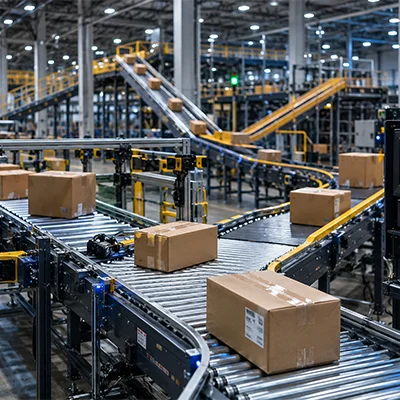
It may seem easy to move materials from one place to another, but the task becomes far more complex when thousands of products need to reach the right destination at the right time. In today's day and age, businesses can overcome this challenge by implementing material flow systems that are smarter, faster, and easier to manage, thanks to modern conveyor control systems. Combined with automation technologies, these systems are becoming an important part of today's industrial logistics operations.
Introduction
Until recently, the subject of conveyors did not come up in the average engineer's conversations. They completed their task without being noticed, pushing cartons, parts or products between work stations. As long as materials kept moving, nobody paid much attention.
Things are different today.
Manufacturers are expected to deliver faster. Warehouses process more orders than ever before. Distribution centers often work around the clock. Under these conditions, even a minor interruption in material flow can have consequences throughout the facility.
This has driven companies to reconsider the flow of materials in their operations.
But more often than not, companies are finding that conveyors are not just tools that work in isolation, but part of a broader logistics strategy. The emphasis is no more on movement. It's about visibility, coordination, responsiveness, and efficiency.
That shift has placed Conveyor Control Systems at the center of many automation projects.
More Than a Conveyor Belt
Anyone walking through a modern fulfillment center will notice that conveyors have become considerably smarter than they were ten or fifteen years ago.
A package approaching a sorting area can be identified automatically. A conveyor section experiencing congestion can adjust its speed. Equipment can communicate with scanners, warehouse software, and nearby machinery without waiting for instructions from an operator.
None of this happens by accident.
Behind the scenes, conveyor automation control systems are constantly collecting information and making decisions. Activity is sensed, data is analyzed by controllers, and software calculates the best route for product flow.
The operator seems to have made a breeze out of the process. But hundreds of microdecisions could be happening every minute.
One of the reasons is that Smart Conveyor Systems can respond rapidly, making them more attractive in various industrial sectors.
Why Material Handling Is Receiving More Attention
Material movement has always been necessary. What has changed is the volume.
A few hundred shipments per day are significantly smaller than thousands of shipments per day. Things are the same in manufacturing environments in which production schedules are getting shorter.
In many facilities, at some point the number of workers added on is not enough to solve the issue.
That's where Material Handling Automation is brought in.
Organizations employ automated material handling systems to streamline and optimize their processes, eliminating the need for manual labor. Continuous movement equipment such as conveyors is frequently used in these systems as the backbone.
These benefits do not just apply to speed.
Automation can help to cut repetitive work, enhance safety, cut down on handling mistakes, and offer greater visibility into daily operations. These can be particularly useful when the business is expanding or there is a rush, e.g. certain seasons of the year.
Why the Control Layer Matters
People talk about conveyor systems when they talk about some motor or belt or rollers and so forth or mechanical details.
Those pieces are all crucial, but many automation experts would say they're not the most important pieces.
What makes the equipment an intelligent logistics solution is the intelligence of the control system.
Imagine a highly congested airport.
While runways are crucial, air traffic management is what enables aircraft to operate safely and efficiently. The same applies to the operations of a conveyor.
Products can build up, bottlenecks can form, and productivity can suffer, if there is no coordination. These situations can be avoided by using a control system for the smart and responsive industrial logistics conveyors to coordinate the movement across the facility.
In many cases, operators may never notice the adjustments taking place. The system simply reacts to changing conditions and keeps operations running smoothly.
The Continuing Importance of PLC Technology
Although new technologies attract significant attention, PLC-based conveyor control solutions remain one of the most widely used automation tools in industrial facilities.
There is a simple reason for that.
They work.
In factories, warehouses and distribution centers, it is not a laboratory setting. Equipment is required to function continuously with reliability under dust and vibration conditions as well as temperature changes.
These realities have been taken into account when designing PLCs.
Their flexibility is equally important.
The operational needs of a facility don't last long. Changes in business workflow are typically necessary for new product lines, evolving customer needs, and expansion of the company.
PLC systems allows for changes to be made often via programming changes, not big equipment changes. This adaptability helps to make expansion projects easier and more cost-effective.
Small Problems Have a Way of Growing
One of the challenges in logistics operations is that small disruptions rarely stay small.
A conveyor jam lasting only a few minutes can delay production schedules. A sorting error can affect downstream operations. A mechanical issue can reduce throughput across multiple departments.
For this reason, many organizations are adopting Smart conveyor systems for logistics that provide greater operational visibility.
Sensors can detect unusual conditions before equipment fails completely. Tools can be used to monitor and find congestion points. Real-time notifications empower maintenance staff to be notified of issues as they occur, giving them the chance to take action promptly.
The goal is not simply to fix issues faster.
The goal is to prevent them from affecting the broader operation in the first place.
Looking Toward the Next Generation
The conversation surrounding Advanced conveyor automation technologies for material handling continues to evolve.
The use of Artificial Intelligence, predictive maintenance platforms, machine vision systems and technologies from the Industrial Internet of Things are starting to shape the way the conveyor network functions.
There are already some facilities that are leveraging predictive analytics to work out maintenance issues before they occur. Others are seeking sustainable AI optimization tools that will be able to suggest the changes in the production process based on its pattern.
There is some variation in adoption, depending on the industry, but the trend is evident.
Conveyor systems are increasingly inter-connected, intelligent, and able to support more complex logistics environments.
Conveyor Control Systems play a crucial role in enhancing the efficiency of industrial logistics
Organizations often ask how conveyor control systems enhance industrial logistics efficiency. The answer usually becomes visible in day-to-day operations.
Materials spend less time waiting.
Product flow becomes more consistent.
Staff have less time allocated to unnecessary interruptions.
Managers have increased visibility in the performance of the system.
Most importantly, facilities are better prepared to respond in the event of a change in conditions.
In this industrial world, flexibility is as much important as speed. Firms which are able to respond rapidly to customer and production demands, and the marketplace conditions, can frequently benefit.
This flexibility is what today's conveyor control systems are meant to help with.
Conclusion
The role of conveyors in industrial logistics has changed considerably. Use to be considered a basic transport solution is now considered as an integral component of a more comprehensive automation approaches. Complimenting Conveyor Control Systems, Material Handling Automation and intelligent software platforms are helping companies to develop logistics operations that are faster, more responsive, and less complicated.
It is likely to become more popular as the industrial plants become more increasingly modern and need smarter conveyor solutions. The investments now will make companies efficient and agile in the years ahead and help them prepare to survive in the future of logistics.
 Our Services
 Media Pack Download
 Newsletters
 Industrial Events