When Factory Roof Repairs Cannot Wait for a Production Shutdown
A leaking factory roof can be an issue even prior to any water getting to the production floor. Water can be collected above a suspended ceiling, dripping onto the stock or into the electrics. You could well have a wet patch on the floor and be suffering from a leaking roof for days.
In a real factory organising repairs is a hell of a lot more complicated than just phoning in a roofer. The production schedule, the deliveries, the plant itself and the safety of the people all have an effect on when the work can be done and how it can be done.
Some of the work will obviously require a complete shutdown. For some of the work we can isolate the area and carry on with production in the rest of the plant. The issue of course is working out which is the safest option.
Factory Roof Leaks and Production Equipment
A leak above an empty storage room is a totally different proposition to a leak above an electrical control cabinet or over an automated assembly line.
It takes absolutely minuscule amounts of water to cause problems. A leak into a sensitive area of a plant can be quite sufficient to stop production. It can also lead to damage to the packaging, the raw materials and the finished product. In a food or pharma environment in a controlled area, water can also give rise to further hygiene and quality issues.
So the leak is just as important as the size of it.
Maintenance will have to work out where the water's ingressing, where it's exiting and what the effect on the operation will be. Those locations are not going to be the same.
Water can run along the roof decking, the beams or the service openings before it actually gets into the building. A ceiling stain doesn't necessarily mean that the leak is directly above it. You need to establish where the leak was, when it was first noticed and what the weather was like at that time. It's also worth noting any plants or machinery, any electrical equipment and any stored materials in the area.
Where water: if water is going to be an issue for the electrical systems or a safety issue then you need to make the area or the equipment safe before you go any further. Age and water build up.
So many factories have flat or low slope roofs and these require a very well designed drainage system to get the rainwater off. Clogged or damaged gutters and standing water can all put an enormous amount of stress on the roof system. Water can accumulate up around the equipment supports, around the roof penetrations and at the areas where the surface has settled.
A drainage problem. A drainage problem is very easily confused with a roof membrane problem. It could be ingress through a damaged joint adjacent to a blocked outlet. Fixing the joint without clearing the blockage would not in any way solve the problem.
Maintenance teams should look at the drainage records and the past repair records before coming to any conclusions as to what action is required. A fairly competent roofer might also want to have a look at the roof itself, the drains, the flashing and the waterproofing. It by no means follows that any particular finding is necessarily indicative of a structural defect. If there is however unusual ponding, visible deformation or any concern at all about roof loading then it would be appropriate for an appropriately qualified engineer to carry out an assessment.
Roof Inspection and Damage Mapping
It's very hard to inspect large factory roofs from the ground with all the roof equipment, ducting, skylights and pipework etc. potentially hiding areas of damage. You obviously need a good record of the roof condition prior to any work commencing and aerial documentation can be of huge assistance in that respect.
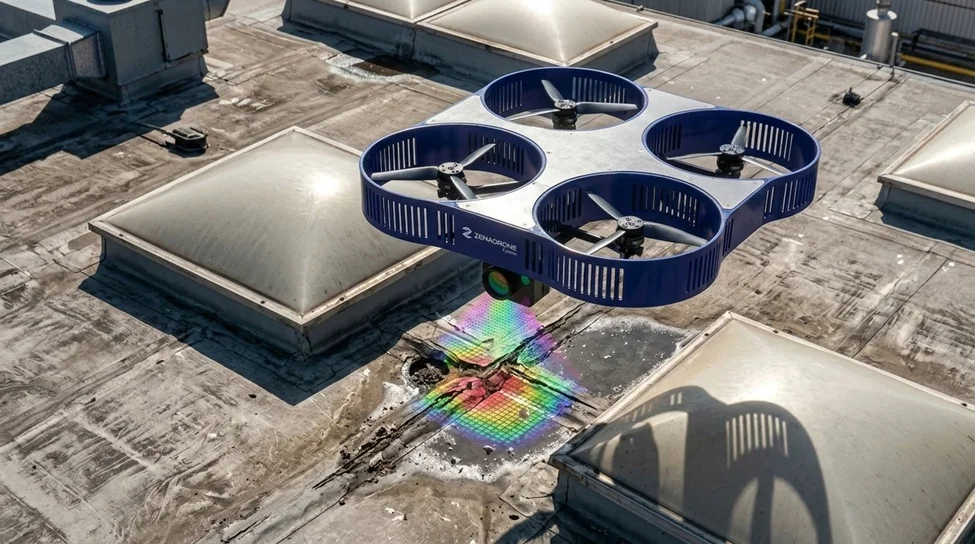
A commercial drone roof inspection can take images of the roof, the drainage, the flashing and the areas around any rooftop equipment. You can then annotate the images with the locations of any defects and pass those on to the contractors and the maintenance team. On a big roof it's a really good way of helping the team to see exactly where the areas of concern are before they go up.
Thermal imaging can also pick up odd temperature patterns which may be indicative of moisture or insulation problems. The issue with that is there are a hell of a lot of things that can cause such patterns. Sunlight, the type of roof, the weather and the heat from the equipment itself can all have an effect.
An aerial survey tells you absolutely nothing about the condition of the hidden roof layers, tells you nothing about structural integrity and of course can't in any way replace a proper hands on inspection when that's required.
The most useful output is actually a roof plan that shows exactly where the problems have been found, what's still not quite clear and what still needs looking at.
This gives the maintenance teams a far better place to start from when actually doing the repair work in the working plant.
Production Zones Beneath the Roof
Once you've established which roof sections are affected you then need to look at what's underneath them. The roofing contractor may well see a fairly minor repair area. The production manager on the other hand may be looking at a critical workstation, a conveyor or a storage area which can't be relocated.
Both views must be considered in conjunction.
Maintenance can match the roof damage plan to the factory floor layout to identify the machinery, walkways, storage and services (both below and adjacent to the work area).
It's normally easier to schedule a repair above a non-critical warehouse aisle than it is above a production line which is running continuously. The location has a bearing on the controls required. Roof repairs can involve falling objects, dust, water, noise, fumes and temporary openings. Some of the methods of repair can also be fire hazardous (particularly where hot work is involved).
The contractor has to take those hazards into account in the method statement and risk assessment. The factory managers also need to consider what the work will mean for production and the people on site next to the work.
Moving stock, fitting appropriate protection or temporarily closing off a production area can all be used to minimise disruption. You must not assume that any of these measures will be adequate without a site specific assessment. Roof work is of course much more than just the work on the roof.
Contractors will need safe access to the building, space for their materials and plant and a clear plan for lifting and moving the supplies. Their work will of course have an impact on the loading bays, vehicle routes and walkways.
If a contractor is bringing in a lifting platform during a delivery period it can cause a bit of a congestion. Storing materials up against an emergency exit is another problem. Any work above areas where forklifts will be operating will require temporary restrictions.
These details need to be sorted out prior to the job actually starting.
The main maintenance team and contractor will determine where the operatives will have access, how the equipment will get to the work area and which routes will need to remain open. The access arrangements will have to take into account the presence of fragile surfaces, skylights, edges and other fall hazards. Work at height will of course be planned and carried out in accordance with the relevant work at height requirements and using the appropriate equipment and controls.
If the works have any effect on ventilation, the electrical system or any other plant equipment then the appropriate technical staff should be involved in the planning.
A clear access plan can certainly go a long way to avoiding any disruption, but you'll still be forced to stop work if the conditions become unsafe.
Repair Schedules and Production Shifts
Factories often have periods when certain sections of the factory are quite quiet.
These are good times for inspections, temporary protection and minor repairs. The quietest time may not necessarily be the safest time for roofing though. The weather, the light, the level of supervision, the availability of the contractor and the nature of the repair will all have an impact on the schedule.
If a repair is going to involve removing a large section of roof covering it may not be safe to do that whilst sensitive equipment is running down below. Any work involving an open flame or ignition source will almost certainly require additional controls and potentially a temporary shutdown of the area.
It's also absolutely vital to draw the line between a temporary fix and a proper permanent repair.
A temporary weatherproofing solution can be used to keep the water out whilst you're in the process of planning and carrying out a more permanent repair. It has to be a proper inspection with a proper follow-up plan rather than a long term fix with no record.
For each repair area the maintenance team will have to set the planned work time, state which production is affected, what has to be isolated and when work must stop. The method of repair is of no consequence as to whether an unsafe method is acceptable.
Maintenance Records and Roof Repair Priorities
Not all the defects can be fixed straight away. On a large site you could have a number of roof defects all vying for the same budget and same amount of contractor time.
Good records obviously assist the teams in making those decisions.
Each issue should have a location, a description, an inspection date and a status. The records should reflect the difference between suspected defects, confirmed defects, temporary fixes and finished repairs.
Priority should be on what would happen if it failed rather than on how the roof is.
A small hole above some critical electrical gear could well be the more serious of the two, than a larger worn area above some bit of space that's not used all that much.
Past repair history is of course absolutely critical. If the same area has been patched several times over then a new patch is likely to be completely ineffective. The roofer will need to go and inspect the drainage, the movement, the fit of the materials, the condition of the roof layers etc. Maintenance records are very useful when there is a change of shift or a change of contractor. You can very easily end up with a patch which you think is a complete fix and in fact it isn't. Roof Repair Verification and Production Restart
The roof work is now complete, that doesn't mean we can go back to normal in the production area.
The contractor must record the work completed and carry out any inspections or tests as specified in the repair plan.
Depending on the type of roof this could involve checking the seams, the flashing, the drainage and all the other bits that have been repaired. The water testing method you use should be appropriate to the roof and of course be agreed with the right people.
Photos taken before and after the works will of course show the changes. They're of course a useful record but on their own they don't prove that the latent defects have been cured.
Inside the factory the maintenance team will have to clear all the protective materials and tools, check that services are safe and do any cleaning or equipment checks. If it's an electrical area, production machinery or a controlled manufacturing area then the appropriate specialist will have to authorise the service return.
The last maintenance record should contain the repair carried out, any further problems and any further inspections that are required.
Factory Roof Maintenance After Repairs
Even after the repairs the roof still requires inspection.
Industrial roofs are of course subject to all the vicissitudes of the weather, temperature differentials and the normal working around roof equipment. A new hole, some maintenance work or a change to the ventilation and other services can have an effect on an area which was previously satisfactory.
A regular inspection plan will pick up any change before it affects production.
Inspection frequency will of course vary according to the age of the roof, its construction and condition, the manufacturer's recommendations and how exposed the site is. You'll obviously be likely to require additional inspections after periods of bad weather and after any significant works to the roof. The drainage outlets must be kept clear and accessible and any new work to the roof must not in any way compromise the integrity of the waterproofing.
Over time you can look at the old photos, the inspection reports and the repair records to see if a problem is recurring or whether a particular bit of roof is degrading. For a factory looking at its maintenance budget and future outages that history is very useful.
Keeping Production Running Without Compromising Safety
Repairing a factory roof isn't just a case of either shutting it down or leaving it alone.
The decision will be driven by the nature of the problem, how it's going to be fixed, what's going on underneath the roof and the risks involved. Some of the work can be done with the rest of the factory still running. Some of it will obviously need a dedicated work area, some will require a temporary shutdown and some will require a more significant shutdown. Accurate roof records, proper inspections and early co-operation between maintenance, the contractors and the production managers will go a long way to making those decisions a lot easier (it's not about eliminating every single shutdown, it's about eliminating the unnecessary ones). It's about getting the roof properly repaired and getting the people working above and below it safe. It's now safe.
Author Bio:

Haroon Ashraf
Senior SEO Specialist at Drone As A Service
Haroon Ashraf is a Senior SEO Specialist at Drone As A Service (part of ZenaTech (Nasdaq: ZENA)) and his focus is on the practical application of drone tech in the construction, infrastructure and facility maintenance space. His aim is to take the technical stuff and make it accessible to the people that are actually making the plans and the operational decisions.
 Our Services
 Media Pack Download
 Newsletters
 Industrial Events