Pressure Measurement Systems: Enhancing Accuracy in Industrial Automation
Introduction: Why Pressure Accuracy Defines Modern Industrial Performance
In modern day strongly automated production, the aspect of precision is not a competitive edge, but rather a necessity. In the oil and gas, pharmaceutical, food processing, power generation, chemical, water treatment and advanced manufacturing sectors, the basis of safe and efficient operations relies on Industrial Pressure Measurement Systems. The variables of pressure have a direct impact on the flow rates, temperature stability, chemical reactions, product consistency and equipment reliability. Even fringy variances would result in energy wastage, compliance risk, downtime or decrease in product quality.
Over the last twenty years, Pressure Measurement Systems have been improved and developed to a great extent. Mechanical gauges have been replaced by intelligent, networked assets that can be subject to continuous diagnostics, proactive warning and flawless integration with the distributed control systems. The digital transformation, Industry 4.0, and smart manufacturing have heightened the need to have high-precision Industrial Pressure Monitoring solutions with real-time data with low drift and high repeatability.
This article discusses the technology, architecture, and strategic significance of the current pressure measurement in industrial automation and provides a practical use of B2B stakeholders who need to achieve better accuracy of operations and ROI.
Understanding Industrial Pressure Measurement Systems
Industrial Pressure Measurement Systems are referred to as complex assemblies that identify, convert, transmit, and analyze pressure data in an industrial process. The systems are usually made up of sensing components, signal conditioning circuits, transmitters, communication interfaces and supervisory control integration.
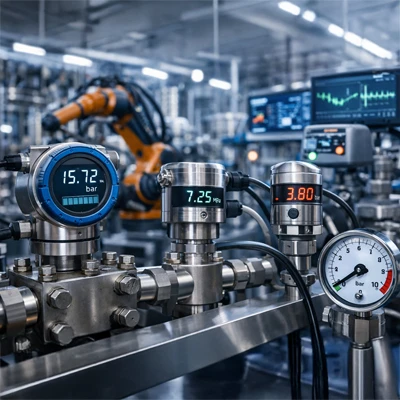
At the centre is Pressure Sensors which are used to physically sense the change in pressure. They are sensors that translate mechanical force to electrical signals and use principles of piezoresistive, capacitive, strain gauge or resonant silicon. Raw signals are then fed into Pressure Transmitters which translate raw signals into standardized output, including 4-20 mA, HART, Modbus or Ethernet-based protocols.
The modern Process pressure monitoring systems are more than measuring. They offer diagnostics, temperature compensation, calibration tracking and integration to plant-wide automation platforms. Remote configuration, wireless communication, and cybersecurity are now anticipated as measures that can be supported by automation pressure measurement devices.
In the case of high-danger industries, safety is directly related to the accuracy of the measurement of the pressure. The events of overpressure may result in the rupture of equipment, environmental risks, or expensive shutdowns. Lack of pressure may cause disruption of production lines or spoilage of products. Therefore, accuracy of measurements is an operation and regulatory priority.
The Role of Pressure Sensors in Process Optimization
Process control loops depend on Pressure Sensors. With fluid handling systems, the pressure information defines the pump efficiency, the position of the valves and the consistency of the flow. Stability of pressure is important in chemical processing, as it affects yield and batch consistency of a chemical reaction. Validated Industrial pressure sensors are used in the manufacturing of pharmaceuticals to guarantee action on high quality and safety standards involved.
Modern pressure sensors targeted at smart factory use now have embedded microprocessors which allow the digital filtering, self-diagnosis and real-time health monitoring. Such sensors are able to sense drift of signal, temperature, or damage on the diaphragm before malfunction or breakdown. This predictive ability decreases unexpected downtime and aids in planning the maintenance.
Specifications of accuracy are very important in sensor selection. Full-scale accuracy, hysteresis, repeatability, long-term stability and temperature compensation are parameters that define whether they are suitable in certain applications. As an example, high-purity processes might need very low measurement uncertainty, whereas industrial systems might need to be very durable and have a high pressure tolerance.
Evolution toward Digital Pressure Transmitters
Plants have been revolutionized by digital pressure transmitters that have changed the manner in which data are handled. They also have a greater resolution, diagnostic error, and a two-way communication facility compared to the analog devices. The digital pressure transmitters are also remotely set and therefore, do not require a person to intervene in the field and save time on workforce.
Those transmitters are associated to control systems in distributed plants through industrial communication protocols. They embrace calibration tracking, tagging of devices and updating the firmware. This connection suits the objectives of Industrial Pressure Monitoring in smart factories, in which machines have to be compatible and data-driven.
Process control high-precision pressure transmitters are also necessary especially in industries like semiconductor manufacturing, biotechnology and the energy production sector. These industries might have slight pressure variation that could influence greatly the quality of output or equipment. With high-accuracy transmitters, there are predictable feedbacks to control systems to provide stable automated regulation.
Digital transmitters are also provided with improved ability to compensate temperature variation and static pressure effects. This is so as to get consistency in measurement amid changing environmental conditions.
Architecture of Process Pressure Monitoring Systems
Contemporary Process pressure monitoring systems are non-autonomous apparatus. They are unified systems of sensing, communication, analytics and control.
The normal system architecture encompasses sensing nodes placed at strategic locations where pipelines, reactors, compressors and storage tanks are located. Data is sent out of these nodes to programmable logic controllers or distributed control systems. Onboard, supervisory programs read and examine trends, raise alarm as well as allow automatic corrective action.
Industrial Pressure Measurement Systems are used in smart manufacturing plants in conjunction with cloud-based highly advanced analytics. Information obtained out of various Automation pressure measurement instruments is combined in order to detect abnormalities, streamline energy consumption, and anticipate equipment deterioration.
Architecture is also getting computed on the edges, which enables data analysis at the device level. This minimizes latency and provides faster reaction to abnormal pressure situations.
Accuracy, Calibration, and Compliance Considerations
The process of maintaining accuracy is a continuous activity and not a first time install. The industrial pressure sensors are to be calibrated after a certain time span to ensure reliability. The calibration intervals are based on the criticality of the process, exposure to the environment and the regulatory requirements.
There are industries that are highly regulated like pharmaceuticals and food production. Validation documentation often contains pressure data. Thus, the Industrial Pressure Monitoring systems have to be able to give traceable calibration records and audit trail.
The influence factors are the variation of temperature, mechanical stress, vibration and media compatibility. The corrosion and drift of measurements are avoided by choosing the right diaphragm material and housing design. Multi-point calibration and sophisticated compensation algorithms are commonly found in process control high-accuracy pressure transmitters to ensure stability on a long-term basis.
The standards of compliance are dependent on the industry and the geographical region but reliability and traceability are universal requirements. The penetration of sophisticated Pressure Measurement Systems minimizes risk in the case of non-compliance punishments or recalling of a product.
Integration with Industrial Automation Platforms
The pressure measurement instruments which are automation-based are geared towards complementing automation systems. The pressure information in the modern plants feeds to high-order control algorithms which control the flow, temperature, and level at the same time.
The integration facilitates the closed-loop control. Custom programmed systems modify the valve, pumps or compressors automatically when pressure is not maintained at a predetermined level. This dynamic response increases stability of production and reduces on wastage.
Advanced pressure sensors have been used in the area of smart factory deployments. These sensors help them to follow the interoperability standards and deliver data in the structured forms that can be used with analytics platforms. The outcome is increased operation visibility.
Integration further assists in the management of energy. Compression optimization in compressed air systems, steam networks and hydraulic systems can greatly cut down on energy use.
Proper monitoring eliminates leakages, excessive compression, and poor operation.
Industry Applications and Strategic Impact
Industrial Pressure Measurement Systems are applied in oil and gas plants to measure the wellheads, pipelines, and refining operations. Precision is important to safety and environmental safety.
In the pharmaceutical manufacturing industry, Pressure Measurement Systems are used to control the process accurately and in a sterile manner. In clean rooms, industrial pressure sensors check the purity of the room and ensure that no batches are broken.
The food and beverage manufacturers are using Digital pressure transmitters to ensure that their operations are hygienic and free of contamination. Stability in pressure guarantees stability in the filling, pasteurization and packaging.
Process pressure monitoring systems are used in Water treatment plants to control filtration, pumping and distribution networks. Infrastructure management is efficient with the assistance of automation pressure measurement devices.
High-precision pressure transmitters used in power generation as a process controller
High-precision process control in power generation boilers, turbines and steam systems are monitored using high-precision pressure transmitters. Precision in measurement has a direct impact on efficiency of plants and equipment life.
In these industries, pressure measurement is not only strategic but operational. Analytical findings enhance the use of assets, minimize downtimes, and sustainability.
Return on Investment and Operational Benefits
It will be possible to obtain ROI on investment in high-level Industrial Pressure Monitoring technology. Reduction in scrap rates and energy usage are achieved with better precision. Predictive diagnostics reduce the cost of maintaining the machine and unexpected downtimes. The workforce productivity is improved by the integration by monitoring and configuring (remotely).
Decision-makers when considering solutions take into account total cost of ownership. Although expensive Pressure Transmitters might be expensive in the short run, their reliability and lower calibration frequency may make them worth the investment in the long run.
The digitalization also allows auditing remotely and centralized monitoring, which will minimize the necessity of physical inspections. This comes in handy especially in risky or geographically scattered locations.
Future Trends in Pressure Measurement
The next generation of the Industrial Pressure Measurement Systems will be described as having increased connectivity, AI-based analytics, and miniaturization. Sensors will be smaller yet they will be providing greater resolution. There will be increased wireless deployments that will make them less complex to install.
The high-pressure sensors to be used in smart factory will include machine learning algorithms that learns the pattern of the process and anticipates anomalies. The aspect of cybersecurity will be a requirement as devices are connected to larger industrial networks.
Development will also be affected by sustainability. The support of greener industrial practice will be presented through energy-efficient sensor design and environmentally resistant material
Frequently Asked Strategic Questions
How frequent calibration is necessary is one of the questions that are often raised by plant managers. The solution relies on the criticality of processes and regulation requirements. The critical control loop might need to be checked on a quarterly basis and less critical applications can be checked on an annual basis.
The other important question is the choice of the analog or digital pressure transmitters. Digital gadgets are more diagnostically superior and have better integration capabilities and are more suitable in modern automation setting.
Questions that also arise within organizations are whether it is worth upgrading the old systems. Migration to more advanced Process pressure monitoring systems impairs the risk of long-term operations in most situations and opens the door to predictive maintenance.
Conclusion: Precision as the Foundation of Industrial Automation
The operation excellence of automated industries is achieved through Pressure Measurement Systems. Since sensing to transmission and analytics, every aspect of the Industrial Pressure Measurement Systems helps to make it safe, efficient, and produce the quality product.
The Industrial Pressure Monitoring will cease being measurement and shift to predictive intelligence as the manufacturing environments become more interconnected. The next step of the industrial innovation will be dictated by high-precision pressure transmitters to control the process and Advanced pressure sensors to use in smart factories.
To B2B decision makers, it is not a mere upgrade to invest in modern Pressure Sensors, Digital pressure transmitters and in-built Automation pressure measurement devices. It is a defensive decision to sustainability, conformity, and sustainable development amid a growing competitive industrial environment.
 Our Services
 Media Pack Download
 Newsletters
 Industrial Events