Essential Electrical Measurement Instruments for Reliable and Efficient Plant Operations
Introduction: Why Electrical Measurement Defines Plant Reliability
The continuity, safety, and life of assets of production in the modern industrial setting depends on electrical systems. Electrical measurement tools are critical in maintaining a stable level of operations whether it is in manufacturing plants and processing plants or even in the utilities and in large scale infrastructure projects. The need to have the correct industrial electrical instruments has never been greater as more and more plants are becoming automated and more and more energetic.
One of the most expensive causes of unplanned downtime in industrial plants is electrical failures. Potential causes of decreased performance in equipment may be voltage instability, insulation breakdown, harmonic distortion, unnoticed current leakage, etc. This is where the electrical testing equipment is important not only as a technical tool of troubleshooting but also as a tactical tool of reliability engineering, preventive maintenance, and energy optimization.
This article discusses the key electrical measurement tools used in the operation of industrial plants, their importance in effective and safe plant operation and the way they are incorporated in the modern plant electrical measurement systems.
Understanding Electrical Measurement in Industrial Contexts
Electrical measurement instruments are special devices that find application to observe, analyze, and check electrical factors of voltage, current, resistance, quality of power, insulation health, and grounding efficiency. These measurements do not occur in factories as one time tests but rather, these measurements are constant monitors of system health.
Residential or commercial tools are not similar to industrial electrical testing instruments. They are to work under increased voltage, in the severest conditions, with sophisticated networks of distribution, and with strict safety requirements. The precision and dependability of their use directly relate to the decision making process based on maintenance planning, equipment replacement and system upgrades.
Electrical measurements used to monitor the work of the industrial plants are designed to fulfill three main functions: compliance with safety, efficiency of equipment, and assistance of predictive and preventive maintenance policies.
Core Categories of Industrial Electrical Instruments
Voltage, Current, and Resistance Measurement Instruments
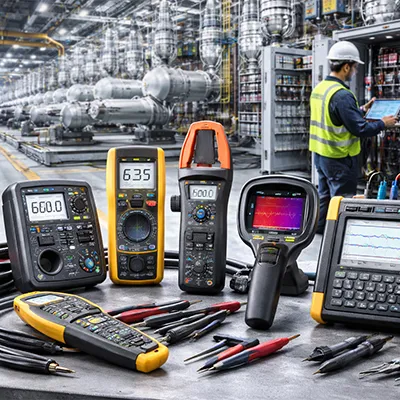
The basic tool of any electrical diagnostics is the equipment used to measure the voltage, current, and resistance. Digital multimeters have become essential electrical tools in the work of the plant, being utilized in commissioning, in troubleshooting, and in the daily check-up of the equipment. In the field of industry the instruments should be able to survive the effects of electromagnetic fields, changes in temperature and mechanical pressure and also provide accurate measurements.
Clamp meters take this a further step to provide the possibility to measure current without breaking live circuits. This feature comes in handy especially in continuous-process plants where down-time is expensive or unfeasible. A combination of these industrial electrical devices is giving real-time information on load behavior, circuit balance and abnormal electrical conditions.
Power and Energy Measurement Systems
Power and energy measuring tools are no longer seen as optional but rather as strategic assets as the cost of energy and sustainability goals are getting increasingly demanding. Advanced electrical measurement systems of a plant consist of power analyzers and energy meters. These meters are used to measure real power, reactive power, apparent power, power factor and harmonic distortion.
The scope of electrical testing tools to provide effective and safe operations of the plant makes more and more emphasis on the analysis of the power quality. Off-quality of power may cause overheating, equipment failure, irritating tripping, and shorter equipment life. Industrial electrical test tools allow detection of harmonics, voltage sags, and transients, and hence engineers can take corrective measures that include harmonic filters or load balancing.
Insulation and Continuity Testing Instruments
In the industrial plants, the major cause of electrical accidents and equipment damage is insulation failure. Megohmmeter, also referred to as insulation resistance testers, are important electrical tools that ensure efficient operation of the plant. They determine the integrity of cable insulation, motor windings, transformers, and switchgear.
Continuity testers Depth Insulation testing Continuity testers supplement insulation testing by confirming the correct connections of conductors and grounding paths. These industrial plant operation electrical measurement tools are used to monitor safety of the electrical operations in safety critical industrial settings to ensure adherence to electrical safety standards, and minimize the likelihood of arc flash effects.
Grounding and Earth Resistance Measurement Tools
Proper grounding is essential in protection of equipment and safety of plants. Ground loop testers and earth resistance testers are special purpose industrial electrical measurement instruments of preventive maintenance. They ensure that the grounding systems have low resistance routes of the fault currents.
Periodic measurement is necessary in the giant plants that have a large grounding network because of changes in the condition of soil, corrosion, and mechanical disturbances. Grounding assessment instrumentation Electricity testing tools help to comply with the regulations and to ensure the safety of the personnel.
Role of Electrical Testing Equipment in Preventive Maintenance
Preventive maintenance, instead of being based on calendar, is given a strategy based on measuring data and is known as condition-based. The key to this change is industrial electrical testing equipment. The plants can identify the onset of degradation and act before the failure by constantly or intermittently observing electrical parameters.
Trend analysis can be performed with the help of electrical measurement tools used to measure the work of industrial plants. Mechanical wear, the entry of moisture or other fluids, or the deterioration of power factor can be noted by a gradual rise in the electric current of the motors, the decreasing insulation resistance, or the declining power factor. These insights will enable the maintenance teams to develop interventions during the planned downtime instead of responding to emergency breakdowns.
Preventive maintenance of the industrial electrical measurement tools also saves the maintenance cost by preventing unnecessary part replacement. Actual equipment state is used to make decisions as opposed to assumptions increasing reliability and utilizing assets.
Integration with Modern Plant Electrical Measurement Systems
Preventive maintenance, instead of being based on calendar, is given a strategy based on measuring data and is known as condition-based. The key to this change is industrial electrical testing equipment. The plants can identify the onset of degradation and act before the failure by constantly or intermittently observing electrical parameters.
Trend analysis can be performed with the help of electrical measurement tools used to measure the work of industrial plants. Mechanical wear, the entry of moisture or other fluids, or the deterioration of power factor can be noted by a gradual rise in the electric current of the motors, the decreasing insulation resistance, or the declining power factor. These insights will enable the maintenance teams to develop interventions during the planned downtime instead of responding to emergency breakdowns.
Preventive maintenance of the industrial electrical measurement tools also saves the maintenance cost by preventing unnecessary part replacement. Actual equipment state is used to make decisions as opposed to assumptions increasing reliability and utilizing assets.
Short Industry Comparison Table: Traditional vs Smart Electrical Instruments
| Aspect | Traditional Instruments | Smart Electrical Measurement Systems |
| Data Collection | Manual, periodic | Automated, continuous |
| Diagnostics | Reactive | Predictive |
| Integration | Standalone | SCADA and EMS integrated |
| Maintenance Impact | Time-based | Condition-based |
| Decision Support | Limited | Data-driven |
Safety and Compliance Considerations
The laws of electrical safety at workplaces continue to be more stringent. Installing of the equipment also necessitates compliance by proper installation and regular checking with certified electrical testing equipment. Electrical devices used in industries should be of international standards in terms of accuracy, insulation ratings and classifications on safety category.
Electrical testing equipment to ensure effective and safe plant operations safeguards equipment and personnel. Proper measurements minimize the chances of arc flash accident, electric shock and fire. Documents of electrical measurements are frequently required in regulated industries, e.g. pharmaceuticals, chemicals and power generation to be audited and certified.
Definition: What Are Industrial Electrical Testing Instruments?
Industrial electrical testing instruments are special tools that are used to quantify, analyze, and check electrical values in high-power, complicated, and safety-critical situations. They are specifically designed to accommodate industrial operating conditions and voltage levels, severe conditions, and certification standards, unlike general-purpose tools.
Selecting the Right Electrical Instruments for Plant Operations
The selection of the required electrical measurement tools must be in line with the complexity of the plant, the level of voltage, industry guidelines, and the maintenance plan. Excessive specification of instruments may add to expenses and under-specification may jeopardize safety and accuracy of data.
Highly automated plants have access to high-quality power analyzers and networked measurements.
The latter may be the main priority of facilities aimed at reliability enhancement, so insulation testing and thermal-electrical correlation tools can be given a higher priority. The trick here is to make sure that the electrical tools used in the operation of the plant are useful not only at the present but also at the future.
FAQ-Style Insights for Industrial Decision Makers
The question posed by plant managers is usually whether an investment in a sophisticated electrical testing equipment is a measureable ROI. Practically, adopting fully electrical measurement programs by plants gives them a shorter downtime, increased energy efficiency, and extended equipment life. Instruments are normally expensive than the prevented failures and energy optimization savings.
The other question that is usually raised is the frequency of testing. Although standards give only minimum standards, the optimum frequency varies depending on the operating conditions, variation in load and equipment criticality. The industry electrical measurement tools used as methods of data-driven approaches to preventive maintenance enable the plants to dynamically adapt the testing intervals.
Future Trends in Electrical Measurement for Industrial Plants
The electrical measurement future is more directly associated with the use of digitalization and the industrial internet. The electrical tools of measuring the work of industrial plants turn smarter, smaller, and are more interconnected. Electrical data analysis and failure pattern prediction are becoming more popular and are done with artificial intelligence and machine learning.
Using electrical testing instruments will also be instrumental in reducing carbon strategies as the need to be more sustainable increases since they will help uncover the areas of inefficiencies and allow optimization of energy. Plants which invest early in the superior plant electrical systems of measuring their plants place themselves in a position of long term resiliency and competitiveness.
Conclusion: Electrical Measurement as a Strategic Asset
Electrical measurement is ceased to be a background maintenance practice but it is a strategic operation which affects the safety of the plant, its efficiency, and profitability. The electrical instruments and electrical testing equipment used in the industry are the sources of the visibility that is needed to proactively control complex electrical systems.
Through the appropriate application of industrial electrical testing equipment, the incorporation of the equipment into the electrical measurement systems of the plants, and the congruence between the measurement practices and the preventive maintenance measures, the industrial plants can realize the availability of the reliable and effective functioning of the plants. In a world that cannot afford to waste time and that needs energy efficiency, fundamental electrical tools that are needed to make the plant operate safely are not a luxury that is needless to be purchased, but a must-have.
 Our Services
 Media Pack Download
 Newsletters
 Industrial Events