Industrial Patterns in Manufacturing: Types, Materials and Casting Applications
Introduction: The Strategic Role of Industrial Patterns
The automotive, heavy engineering, aerospace, energy, railways and industrial machinery markets are the key manufacturing industries that rely on industrial patterns in manufacturing. In B2B manufacturing ecosystem, cost control, precision and repeatability are key performance indicators. The fundamental aspect of these metrics is the art of pattern making - the process of making a replica pattern that is used to cast molds.
The casting patterns or foundry patterns dictate the dimensional accuracy of the castings, the surface finish, structural integrity of the castings, among other factors, and the overall manufacturability of the castings. The industrial patterns applied to metal casting purposes in the production of engine blocks, pump housings, turbine casings or valve bodies will have a direct bearing on the yield rates, speed of production and the rejection percentages.
Pattern making is no longer a wholly manual craft in the modern manufacturing. It combines engineering design, material science, digitization, and computerized fabrication technology. This article will discuss the pattern types, pattern material used in casting, pattern making methods, and strategic considerations of these in the large-scale industrial production.
Understanding Industrial Patterns in Manufacturing
An industrial pattern is an imitation of an element that serves to establish a hole in the molding material to cast. The shape of the final part of the cast, taking into consideration the shrinkage, machining and draft creates the cavity.
The patterns of casting are designed instruments and not mere models. Their design incorporates:
- Shrinkage allowances based on alloy type
- Machining allowances for finishing operations
- Draft angles for easy removal from molds
- Core prints for hollow sections
- Gating and riser integration in some configurations
The casting pattern design and production procedure thus requires a good knowledge of metallurgy, thermal behavior, and properties of mold material.
Types of Casting Patterns in Foundry Operations
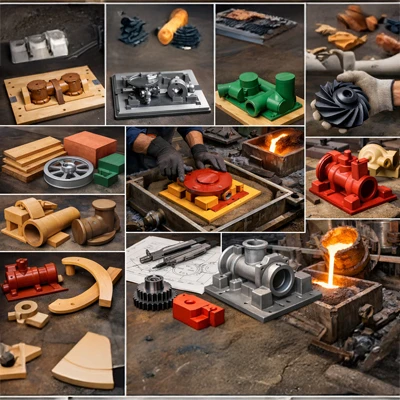
The various kinds of casting patterns in foundry environments are dependent on volume of production, geometry and size as well as complexity of parts. Pattern configurations are chosen by the industrial foundries in order to maximize their productivity and minimize the operating cost.
Single Piece Pattern
It is the easiest casting pattern. It is normally applicable in low volume production and straightforward geometries. The pattern is created as a single piece and would be appropriate in small pieces with undercuts which are small.
Split Pattern
Split patterns are widely used in the industrial foundries, and they have been subdivided into half along a dividing line. This allows easy removal out of the mold and allows medium-complex geometries. Automotive and pump casting industries use split casting patterns.
Match Plate Pattern
Match plate patterns are popular in high-volume manufacturing set ups. There are gating systems as well as both sides of the pattern are put on two separate plates. This gives high dimensional precision and fast production of molds making them suitable in the production of molds on an automated molding line.
Cope and Drag Pattern
Castings of large and heavy weight are best mounted in separate cope and drag halves so that they can be handled with greater efficiency. Such an arrangement is typical to heavy machinery and industrial equipment manufacturing.
Loose Piece Pattern
Complex parts having projections or undercuts tend to be loosely fitted which is removable individually during mold preparation. The method can ensure that there is no destruction of molds and can preserve the detailed design.
Gated Pattern
Various patterns in a mass production setting are linked together by a unified gating system. This enhances productivity in a single mold and efficiency of flow of metals.
The decision between these kinds of casting patterns directly relates to the strategy of the design of casting patterns and the economies of scale.
Industrial Pattern Materials: Performance and Durability
The choice of the most suitable materials to cast the pattern during foundry is a critical choice that determines the pattern life, cost per casting, and the quality of the surface. The pattern material used in the industry should be able to endure abrasion, moisture, temperature changes, and frequent use.
Wood
Wood is traditionally used in the manufacture of patterns, but can still be used in short production batches and prototype. It is inexpensive and simple to machine, however it is not very durable when used in high volume industrial applications.
Metal
Metal casting aluminium and cast iron have been commonly employed in industrial patterns. Metal patterns have got good dimensional stability and have a long life. They are optimal in automated foundry and cyclic casting.
Plastic and Polymers
The lightweight nature and excellent wearing characteristics of polyurethane and epoxy based materials are some of the reasons why engineering plastics are used more and more. These are cost effective and durable materials.
Foam Patterns
Expendable foam patterns are used in processes of lost foam casting. The technique is applicable in intricate shapes, and less cores are required.
Composite Materials
The up-to-date pattern making methods of casting incorporates composite materials that can be used in casting with strength, low weight, and thermal resistant. They are particularly useful when it comes to aerospace and precision engineering.
The criteria to be used in making the decision of the industrial pattern materials are the analysis of production volume, alloy type, anticipated pattern life, and dimensional tolerances.
Pattern Making Techniques for Casting
The development of pattern production represents the wider shift in technologies of manufacturing. The art of the craft has been enhanced by computer accuracy.
Conventional Machining
Woodworking and metal machining continued to be used in smaller foundries and repair work, which is still done manually. The engineering drawings are read and interpreted by well-trained pattern makers who come up with exact replicas.
CNC Machining
High repeatability and narrow tolerances are guaranteed through Computer Numerical Control machining. It is widely applied in the creation of complex patterns of casting in the automotive and heavy equipment sectors.
3D Printing and Additive Manufacturing
Additive manufacturing has transformed the design of patterns during casting. Quick prototyping enables the use of fast iteration, short lead time, and low cost small batch manufacturing. It also aids in complex internal geometries which would be difficult using the traditional methods.
CAD-Driven Pattern Design
In recent pattern design and casting technique, 3D CAD modeling is initially used. The simulation program helps forecast the shrinkage, porosity and thermal characteristics, eliminating experimentation in foundries.
Industrial trends in the manufacturing industry are becoming precise, replicable, and responsive to individual production by incorporating digital technology.
Casting Pattern Design: Engineering Considerations
Pattern design Casting is a multidisciplinary engineering operation. It has to consider the dynamics of metal flow, cooling rate, strength of moulds as well as finishing.
Key considerations include:
Dimensional allowance makes sure that the reduction in solidification does not affect the final specifications. Draft angles also help in the easy extraction of molds without any damage to cavity surfaces. Core prints help in supporting internal cavities. Pattern materials and machining accuracy depend on the requirements of surface finish.
The metal casting applications must also have industrial patterns that are consistent with downstream activities such as machining, coating and assembling.
The ineffective pattern design may cause misruns, shrinkage anomalies and rework, which hikes the cost of production.
Applications across Industrial Sectors
Industrial casting patterns have a very broad range of industries.
The automotive industry is one of the industries that rely on precision foundry patterns, e.g. engine blocks, transmission housings, brake parts and cylinder heads. Ministry of energy uses casting patterns under turbine casings, pump bodies and valve assemblies. Casting patterns used in infrastructure and heavy engineering industries are structural brackets, gear housing, and industrial frames.
The production of railways involves the use of casting patterns of bogie frames and coupling systems that are durable. Agricultural machinery manufacturers rely on castings of gearsboxes, axles.
The design of every application will require specific casting pattern design depending on the load, choice of alloy and operational environment.
Comparative Overview of Pattern Materials
Material Type | Durability | Cost | Application Volume | Typical Use
Wood | Moderate | Low | Low | Prototyping
Aluminum | High | Medium | Medium to High | Automotive castings
Cast Iron | Very High | High | High | Heavy machinery
Plastic | High | Medium | Medium | Precision components
Foam | Single Use | Low | Medium | Complex shapes
This analogy can help procurement departments to make the most appropriate choices regarding which materials to use in foundry casts depending on ROI and keeping the life span of the material.
Quality Control in Industrial Pattern Manufacturing
Pattern making must be done with quality assurance in the quest to ensure consistency of casting. Checks of dimensional verification through coordinate measuring machines make sure that tolerances in design are met. Reusable patterns are worn or damaged and the wear or damage is detected by surface inspections. Pattern life is increased and unforeseen downtime is minimized through maintenance schedules.
Pattern storage protocols have also been introduced to foundries to avoid absorbing moisture and warping. Usage cycles are tracked digitally and thus predictive replacement planning is possible.
Economic Impact of Effective Pattern Design
Casting is a pattern design and manufacturing process, which has a major effect on the economics of production. Proper casting patterns will cut scrap levels, rework and saving on metal. Effective gating systems improve ratio of yields and decrease wastes.
In the case of B2B manufacturers, an investment in cutting-edge pattern making techniques of casting translates into competitive advantage. Shortened lead times and stable quality enhance credibility of the suppliers in the international markets.
Frequently Asked Industry Questions
How do industrial patterns in manufacturing affect casting defects?
The accurate design of the casting patterns reduces defects like shrinkage holes, misalignment and surface abnormalities. The gating integration and proper allowances enhance the control of metal flows.
What are the best materials for foundry casting patterns in high-volume production?
Metal designs, especially aluminium, and cast iron are desirable because they are durable and stable in size.
How is digital technology changing pattern making?
CAD modelling, simulation software, and 3D printing improve the accuracy of design and minimise time-to-market of new casting projects.
Future Trends in Casting Patterns and Foundry Patterns
Industrial 4.0 technologies integration is changing the trend in industry used in casting metals. Virtual testing prior to actual production is possible through digital twins. Additive manufacturing is in favor of hybrid pattern systems. Materials that are sustainable are under consideration to cut the impact to the environment.
Molding lines require automation which is more precise and compatible with robots handling systems. With the growth of manufacturing processes all over the world, the strategic role of the casting patterns is only going to continue to grow.
Conclusion
Industrial Patterns in Manufacturing is a very important cross-section of precision engineering, material science and manufacturing plan. Pattern making is the key to casting success whether it is traditional patterns developed in wood or is digitally engineered in aluminum and composite.
Knowledge on the varieties of casting patterns in foundry activity, the choice of suitable industrial pattern materials, and application of advanced pattern making methods in casting are vital in the attainment of operational excellence. The manufacturing pattern design and the process of casting is not just one stage of preparation but one of the value drivers in the industrial production.
The casting patterns will keep on changing as the global industries require a better quality, low costs and quick turnaround. Those manufacturers investing in novel casting pattern design and strong industrial pattern material will be more competitive within B2B markets and will be able to sustain their trends in the metal casting practice.
 Our Services
 Media Pack Download
 Newsletters
 Industrial Events