Modern Industrial Controls & Relays: From Traditional to Intelligent Systems
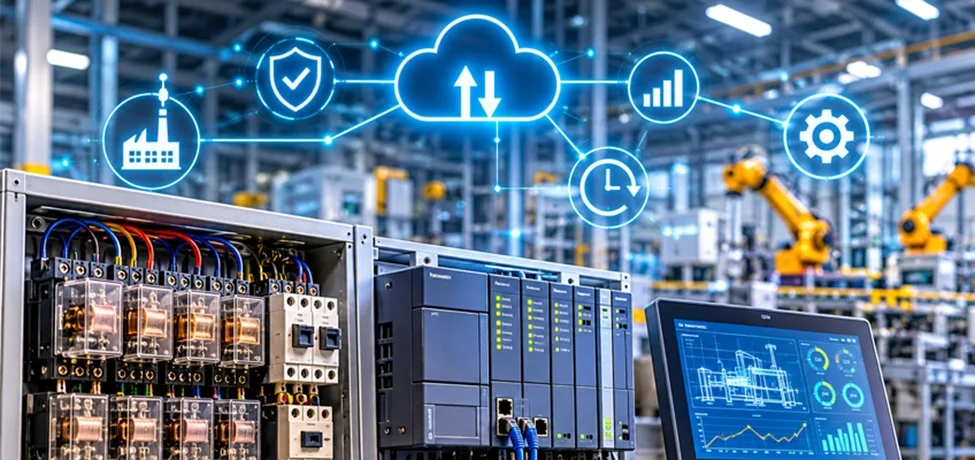
Industrial controls have moved from clunky relay panels to connected, self-diagnosing systems. This article explains how industrial relays still protect plants, how intelligent control systems add data and predictive insight, and how modern manufacturers can upgrade step by step without costly unplanned shutdowns or abandoning their proven hardware.
Quick answer: Industrial controls (PLCs, sensors, drives) run the machine, while industrial relays switch and protect its circuits. Intelligent systems merge the two: relays and controllers that sense, log, and communicate, so plants prevent faults instead of just reacting to them.
There was a time when you could judge a factory by its sound. Step onto the floor of a plant built in the 1980s, and the verdict arrived before your eyes had adjusted: the steady, metallic clack of electromechanical relays opening and closing behind cabinet doors. To the people who worked there, that rhythm meant one thing. The line was alive.
Today, many of those same plants run on intelligent industrial control systems that are almost silent, but far more talkative in a different way. They send data. If you manage maintenance, design panels, or simply want fewer 3 a.m. breakdown calls, this shift matters. Here's a plain-English guide to how industrial controls and relays evolved, what "smart" really means, and how to upgrade without chaos.
What are industrial controls?
Industrial controls are the devices and software that tell machines what to do, and when. Think programmable logic controllers (PLCs), motor drives, sensors, timers, push buttons, and human-machine interfaces (HMIs). Together they start motors, regulate temperature, count products, and keep processes safe.
Good controls do three jobs: sense what's happening, decide what to do, and act. When any one of those fails, you get scrap, downtime, or worse. That's why industrial controls are often called the nervous system of a factory.
What do industrial relays do?
An industrial relay is an electrically operated switch. A small control signal switches a much larger load, and it keeps low-voltage logic electrically isolated from high-power circuits. The main types are:
- Electromechanical relays (EMRs): physical contacts; simple, rugged, and familiar
- Solid-state relays (SSRs): no moving parts, fast switching, long service life
- Protection relays: monitor current, voltage, and frequency, then trip a breaker when something goes wrong
- Time and monitoring relays: handle delays, phase loss, and under-voltage conditions
Industrial relays are still everywhere because they do one job extremely well: they isolate, switch, and protect.
How did industrial control evolve from traditional to intelligent?
Nobody woke up one day and replaced every panel. The change happened in stages, and each stage kept what worked while adding something the last generation couldn't do.
|
Era |
Typical technology |
Main strength |
Main limitation |
|
1950s–60s |
Hard-wired relay logic |
Simple, visible, rugged |
Rewiring for every change |
|
1970s–80s |
PLCs |
Programmable and flexible |
Standalone, little data |
|
1990s–2000s |
Networked controls, fieldbus, SCADA |
Central monitoring |
Siloed, complex systems |
|
2010s–today |
Smart controls, IIoT, edge analytics |
Predictive insight, remote diagnostics |
Needs cybersecurity and new skills |
What makes a control system "intelligent"?
Intelligent industrial controls don't just follow instructions. They notice, report, and adapt. Look for these traits in smart control systems:
- Self-diagnostics: the device knows when it's wearing out and says so
- Connectivity: Ethernet-based protocols such as EtherNet/IP, PROFINET, Modbus TCP, and OPC UA
- Data logging: timestamped events, so root-cause analysis isn't guesswork
- Predictive maintenance: contact wear, load trends, and temperature drift flag problems early
- Remote access: fewer trips to the cabinet for configuration and troubleshooting
- Built-in cybersecurity: role-based access and secure communication
In short, smart industrial automation controls turn a machine from a black box into something your team can actually understand.
Why does advanced relay technology matter in modern manufacturing plants?
Relays haven't gone away. They've gotten smarter. Advanced industrial relay systems now include digital protection relays that talk over standard protocols, solid-state relays with built-in diagnostics, and smart interface modules that report their health to the PLC.
Here's what that looks like in practice. A motor starts drawing slightly more current each week. A traditional relay does nothing until it trips. A smart relay logs the trend, alerts your team, and lets you replace a worn bearing during a planned stop. Same motor, very different outcome.
For modern manufacturing plants, advanced relay technology also means smaller panels, faster fault location, and easier alignment with safety and energy-management goals.
How do industrial control and protection systems work together?
Control keeps production running. Protection keeps people and equipment safe. They used to live in separate worlds, but now they share data.
When a protection relay detects an overload, it can trip locally and notify the control system, which pauses the line gracefully instead of crashing it. That coordination cuts nuisance stops and shortens restart time. It's the difference between slamming the brakes and easing off before the curve.
One caution: safety functions should stay on certified, safety-rated devices. Intelligence is a bonus, never a substitute for proper safety design.
Traditional vs. intelligent controls: a quick comparison
|
Feature |
Traditional systems |
Intelligent systems |
|
Fault detection |
After the failure |
Before the failure |
|
Data |
Almost none |
Continuous, timestamped |
|
Troubleshooting |
Multimeter and guesswork |
Event logs and remote diagnostics |
|
Changes |
Physical rewiring |
Reconfigure in software |
|
Maintenance |
Reactive or fixed schedule |
Condition-based |
|
Panel size |
Large |
Compact |
|
Upfront cost |
Lower |
Higher, often offset by less downtime |
What are the benefits of intelligent industrial control systems?
- Less unplanned downtime: early warnings let you fix issues on your schedule
- Faster troubleshooting: technicians see the exact fault, not just a dead machine
- Better energy use: monitoring reveals idle loads and inefficient motors
- Safer operations: coordinated protection and clearer alarms
- Easier scaling: adding a line means configuring, not rewiring
These gains show up across industries, from food and beverage lines to automotive assembly and pharmaceutical packaging, anywhere a stopped machine costs real money every minute.
How can you upgrade without shutting down production?
1. Audit what you have. List your relays, controllers, and the machines they run. Note which ones fail most often.
2. Start with pain points. Pick the machines with the most downtime, not the whole plant.
3. Choose open standards. Equipment that speaks common protocols helps you avoid vendor lock-in.
4. Pilot one line. Prove the value there, then scale.
5. Plan cybersecurity early. Segment networks and control access before you connect anything.
6. Train your team. Technicians who trust the data will actually use it.
Common mistakes to avoid
- Ripping out everything at once instead of upgrading in phases
- Paying for smart features nobody will use
- Ignoring existing wiring, standards, and spare-parts inventory
- Connecting devices to the network without a security plan
Frequently asked questions
What is the difference between a relay and a PLC?
A relay is a single switching device. A PLC is a programmable computer that can replace hundreds of relays with software logic. In most plants, they work side by side.
Are industrial relays obsolete?
No. Relays remain essential for isolation, switching, and protection. What's changing is that modern industrial relays are more compact, more reliable, and often communication-ready.
What are intelligent industrial control systems?
They are control systems that combine PLCs, smart sensors, and networked devices to monitor conditions, log data, diagnose faults, and support predictive maintenance.
Are solid-state relays better than electromechanical relays?
It depends on the job. Solid-state relays suit fast, frequent switching and long life. Electromechanical relays suit varied loads, low cost, and simple applications.
How do smart control systems reduce downtime?
They spot early warning signs such as rising current or contact wear, and they give technicians precise fault data, so repairs are quicker and better planned.
Final thoughts
The move from traditional to intelligent industrial controls isn't about throwing away what works. It's about adding visibility to the hardware you already trust. Start small, pick one problem machine, and let the data make the case for the next upgrade.
 Our Services
 Media Pack Download
 Newsletters
 Industrial Events