Industry 4.0 & Industrial Internet: Building the Connected Smart Factory
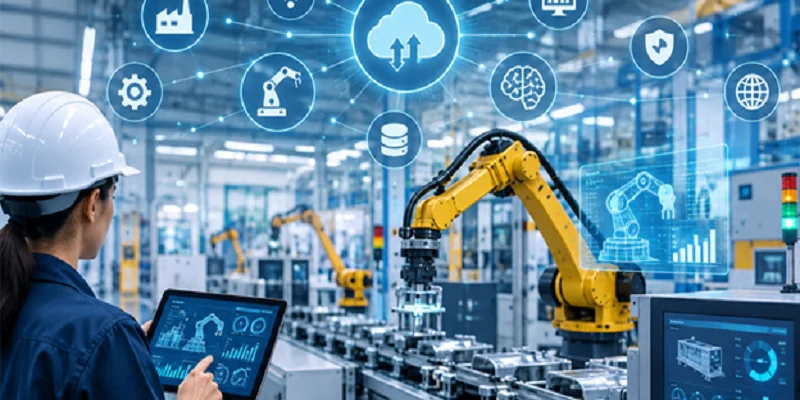
Manufacturing is going through its biggest shift since the assembly line. Factories that once ran on fixed schedules, manual inspections, and siloed machines are now becoming connected, data-driven ecosystems. This shift has a name: Industry 4.0, and its backbone is the Industrial Internet.
If you're evaluating how to modernize your production floor, this guide breaks down what a Connected Smart Factory actually looks like, the technologies that power it, and a practical roadmap for getting there.
What Is Industry 4.0, Really?
Industry 4.0 refers to the fourth industrial revolution - the integration of digital technologies like sensors, cloud computing, artificial intelligence, and automation into physical manufacturing processes. Instead of machines operating in isolation, they now talk to each other, to software systems, and to the people managing them.
At the center of this revolution sits the Industrial Internet - a network of connected machines, sensors, and systems that continuously collect and exchange data. Think of it as the nervous system of a modern factory: every machine is a sensor, every process generates data, and every decision can be informed by real-time information instead of guesswork.
Smart Manufacturing: Moving From Reactive to Predictive
Traditional manufacturing is largely reactive. A machine breaks, production stops, someone calls maintenance, and the line sits idle until it's fixed.
Smart Manufacturing flips this model. By combining sensor data, machine learning, and real-time analytics, manufacturers can predict failures before they happen, adjust production parameters on the fly, and optimize output without human intervention at every step.
Key benefits of smart manufacturing include:
- Reduced downtime through predictive maintenance
- Higher yield via real-time quality monitoring
- Lower energy costs through adaptive resource management
- Faster time-to-market with agile, reconfigurable production lines
This is where Industrial IoT (IIoT) becomes essential - it's the technology layer that makes smart manufacturing possible.
Industrial IoT: The Foundation of the Connected Factory
Industrial IoT refers to the network of internet-connected sensors, devices, and machines used specifically in industrial settings - as opposed to consumer IoT (like smart thermostats or fitness trackers).
In a factory setting, IIoT devices might include:
- Vibration sensors on motors to detect early signs of wear
- Temperature and pressure sensors on production equipment
- RFID tags for real-time inventory and asset tracking
- Connected robotic arms that report performance metrics
- Environmental sensors monitoring air quality, humidity, or emissions
The data from these devices flows into centralized platforms where it's analyzed, visualized, and acted upon - either automatically or by human operators.
Industrial IoT Solutions typically combine four layers:
- Sensing layer – physical sensors and devices collecting raw data
- Connectivity layer – networks (5G, Wi-Fi 6, LPWAN, Ethernet/IP) transmitting that data
- Data platform layer – cloud or edge computing systems processing the data
- Application layer – dashboards, alerts, and automation logic that turn data into action
What Makes a "Connected Smart Factory" Different
A Connected Smart Factory isn't just a facility with a few smart sensors bolted on. It's a fully integrated environment where machines, software, supply chains, and people are linked through a shared data layer.
Characteristics of a truly connected smart factory:
- End-to-end visibility — from raw material intake to finished product shipment
- Interoperability — machines from different vendors communicate through common protocols (like OPC-UA or MQTT)
- Real-time decision-making — dashboards and AI systems flag issues as they happen, not after a shift ends
- Digital twins — virtual replicas of physical equipment or entire production lines used to simulate and test changes before applying them
- Human-machine collaboration — operators use AR/VR tools, tablets, and AI assistants alongside automated systems
This level of integration is what separates a digitized factory from a genuinely smart one.
Core Industry 4.0 Technologies Powering Smart Factories
Several technologies work together to enable this transformation:
1. Industrial IoT & Sensors
The data-collection backbone, covered above.
2. Cloud & Edge Computing
Cloud platforms handle large-scale data storage and analytics, while edge computing processes time-sensitive data locally on the factory floor — critical for applications like robotic control, where milliseconds matter.
3. Artificial Intelligence & Machine Learning
AI models analyze sensor data to predict equipment failures, optimize scheduling, detect defects using computer vision, and even adjust production parameters autonomously.
4. Digital Twins
Virtual models of physical assets let engineers test process changes, simulate failures, and optimize layouts without disrupting live production.
5. Robotics & Automation
Collaborative robots ("cobots") work alongside human operators, handling repetitive or hazardous tasks while adapting to changing production needs - a core pillar of Smart Factory Automation.
6. 5G and Advanced Connectivity
Low-latency, high-bandwidth networks enable real-time communication between hundreds or thousands of connected devices on a single factory floor.
7. Cybersecurity Frameworks
As factories become more connected, they become more exposed. Industrial cybersecurity -segmented networks, zero-trust access, and continuous monitoring — is now a non-negotiable part of any smart factory build.
How to Build a Connected Smart Factory: A Practical Roadmap
Building a smart factory isn't a single project - it's a phased transformation. Here's a practical approach:
Step 1: Audit Your Current State
Map existing equipment, data systems, and manual processes. Identify where visibility is weakest - that's usually where IIoT sensors deliver the fastest ROI.
Step 2: Start With High-Impact Use Cases
Don't try to digitize everything at once. Common starting points include predictive maintenance on critical machines, real-time production monitoring, or automated quality inspection.
Step 3: Build the Connectivity Layer
Choose network infrastructure (Wi-Fi 6, 5G, or wired industrial Ethernet) that can scale as you add more connected devices.
Step 4: Implement a Unified Data Platform
Avoid data silos. Use a centralized platform - cloud, edge, or hybrid - that can ingest data from multiple machine types and vendors.
Step 5: Layer in Analytics and AI
Once clean, structured data is flowing, apply analytics dashboards and machine learning models to generate predictive insights, not just historical reports.
Step 6: Scale Gradually
Expand successful pilots across other lines or facilities, refining your architecture as you go.
Step 7: Partner With Experienced Providers
Most manufacturers don't build this in-house from scratch. Working with providers offering proven Smart Factory Solutions and Industry 4.0 solutions for smart factories significantly shortens deployment time and reduces integration risk.
The Business Case: Why This Matters Now
Manufacturers adopting connected smart factory models are reporting measurable gains in production efficiency, equipment uptime, and quality control. Beyond the operational upside, connected factories are also more resilient - able to reconfigure quickly in response to supply chain disruptions, labor shortages, or shifting demand.
As competitors adopt Industry 4.0 technologies, the gap between digitized and traditional manufacturers will only widen. The question isn't really if factories should connect their operations - it's how fast they can do it without disrupting existing production.
Frequently Asked Questions
What is the difference between Industry 4.0 and Industrial IoT?
Industry 4.0 is the broader movement toward digitized, data-driven manufacturing.
Industrial IoT is one of its core enabling technologies - the network of connected sensors and devices that collects the data Industry 4.0 systems rely on.
What industries benefit most from smart factory automation?
Automotive, electronics, pharmaceuticals, food and beverage, and heavy machinery manufacturing see some of the highest returns, largely due to complex, multi-step production processes where downtime and defects are costly.
Is building a connected smart factory expensive?
Costs vary widely based on scope. Starting with a focused pilot - such as predictive maintenance on a few critical machines - allows manufacturers to prove ROI before scaling investment across the full facility.
How long does it take to implement Industry 4.0 solutions?
A single use-case pilot can go live in a few months. Full-scale smart factory transformation typically unfolds over 1–3 years, implemented in phases.
Do I need to replace existing machinery to adopt IIoT?
Not necessarily. Retrofit sensors and IIoT gateways can often be added to existing equipment, making it possible to modernize without a full hardware overhaul.
Final Thoughts
The connected smart factory isn't a distant concept - it's already operational in leading manufacturing facilities worldwide. What separates early adopters from the rest isn't access to better technology; it's a clear, phased strategy for implementation.
Whether you're just beginning to explore Industrial IoT solutions or planning a full smart factory rollout, the path forward starts with visibility: connect your data, then let that data guide every decision after.
 Our Services
 Media Pack Download
 Newsletters
 Industrial Events