How to Choose the Right Traceability Partner for Modern Workcells
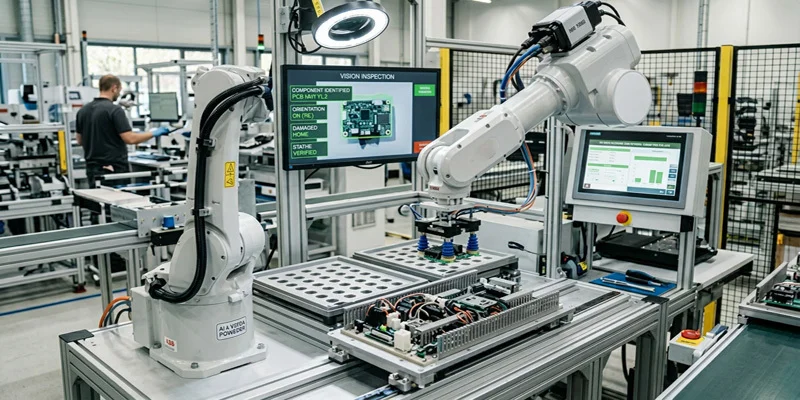
In manufacturing workcells, laser marking systems work with automated controls and quality verification processes. As Industry 4.0 turns factories into digital ecosystems, traceability has taken on more roles besides regulatory compliance. Manufacturers need marking technology that can exchange data with manufacturing execution systems and keep pace with high-speed production lines without introducing integration complexity.
The Role of Traceability in Modern Workcells
Manufacturing traceability creates a reliable digital link to physical components throughout their life cycle. Permanent identifiers make that connection possible by supporting quality control, genealogy tracking and regulatory requirements. When manufacturers combine supply chain event data with cryptographic verification, they can track product provenance through a secure timeline without centralized repositories.
Industry 4.0 improves this connection as robots and manufacturing software exchange production data automatically. It allows industrial traceability marking to support real-time process monitoring and faster feedback loops. However, the technology is only as useful as it is reliable. It still depends on how consistent the marking system performance is within the workcell environment.
Evaluating Total Cost of Ownership Beyond the Initial Price
The purchase price is only a part of the total cost of ownership (TCO) for manufacturing equipment. Third-party integrator fees and configuration requirements can add expenses, while production downtime introduces steeper costs. With automotive manufacturers losing $2.3 million per hour during halted production, reliability and rapid deployment can have a major financial impact.
Those costs can become harder to control when multiple vendors are in charge of marking hardware, integration and software. More parties can result in complex coordination when something goes wrong. That’s why manufacturers should consider life cycle costs and ongoing support when comparing potential partners.
What Are the Differences in Software, Support and Customization Between Keyence and Telesis?
Telesis Technologies, Inc. and Keyence can help manufacturers who need advanced marking solutions. Both support production environments, but they each approach marking technology and workcell integration differently.
Telesis Technologies, Inc.: Robust Customization and Full-Stack Integration
Telesis Technologies, Inc. offers marking hardware with engineering, proprietary software and complete workcell integration services. The company provides turnkey solutions in-house to reduce manufacturer dependence on third-party integrators. It has XpressMark MOPA™ lasers in 30W, 60W and 100W options, so that customers have scalable power choices for diverse applications.
Its in-house engineering team can adapt systems to demanding industrial facilities and existing production processes. Telesis also builds all its dot peen markers in the U.S. to support manufacturers who want domestic production partnerships. These capabilities enable the company to make a complete laser marking system around individual application requirements.
Key Features
- Turnkey services: In-house engineering removes third-party costs and speeds up deployment timelines.
- Proprietary software: Flexible marking software adapts to production requirements and existing manufacturing systems.
Keyence: Precision and Vision Integration
Keyence designs its laser marking systems for precision in automated manufacturing. For example, the 3-Axis Hybrid Laser Marker MD-X Series uses conventional fiber with YVO4 lasers to handle a wide range of applications. Its built-in vision features also find the part and adjust the mark based on its position to help automated lines handle variation without manual help.
Consistency is important when components do not land in the same position every time. Keyence uses special optical systems to maintain sharp edges and accuracy even with misaligned targets. These features make its industrial traceability marking systems ideal for standardized, automated applications.
Key Features
- Vision-guided positioning: Automated part recognition adjusts marking parameters based on actual location and orientation.
- Hybrid laser technology: Combined fiber and YVO4 lasers provide marking flexibility across different application requirements.
Material Range and Multisurface Capabilities
Testing marking technologies with actual materials and production conditions before purchasing helps avoid costly mismatches. Keyence excels in precise laser marking and optical positioning, particularly when components arrive at consistent positions with predictable geometries.
However, curved, uneven or irregular components can make fixed-distance marking more challenging. Telesis’ dot peen markers overcome these hurdles using stepper motors and precise pin locations. Because the pin floats, the equipment can mark on curved and irregular surfaces consistently. This patented technology also lessens unwanted vibration, which can simplify working with challenging geometries.
Telesis offers direct part marking for secure, permanent marks just below the surface. This approach creates highly secure identification that cannot be peeled off or removed, supporting long-term traceability requirements. Manufacturers should also consider how their product mix may change over time. Testing different technologies against current and anticipated applications can help them scale easily.
Comparing Service, Support and Longevity
Service availability directly affects equipment uptime and long-term TCO of traceability systems. Keyence operates 250 offices in 46 countries, with engineers supporting 400,000 customers worldwide. Telesis takes a different approach with U.S.-based service and repair, emphasizing direct, long-term partnerships.
On-site training can help operators and maintenance teams troubleshoot issues without waiting for third-party assistance. Still, Telesis builds its laser marking system equipment for longevity, ideal for demanding customers such as tier-1 automotive suppliers.
Manufacturers should compare more than the equipment itself when choosing traceability partners. Response times, technician availability, training programs, spare parts accessibility and long-term system commitments all influence operating costs. These service differences become more important as equipment ages and production requirements change.
Frequently Asked Questions
Here are some common questions about finding manufacturing traceability partners.
What should manufacturers consider when integrating traceability into an automated workcell?
Start with the bigger picture rather than comparing marking equipment in isolation. Manufacturers should consider integration costs, material compatibility and ongoing technical support. Marking systems must also communicate reliably with vision systems and production software for industrial traceability marking to succeed.
How does workcell integration affect the total cost of a traceability system?
The equipment price is only one element among the total investment cost. Programming time, third-party integrator fees and ongoing maintenance requirements can add to this in the long term. Turnkey partners bring installation and future upgrades under a single provider, which can reduce total cost and streamline coordination with vendors.
Which marking technology works best for curved or irregular surfaces?
When working with curved or irregular parts, there’s no one-size-fits-all marking solution. Shape, material and the required mark all influence its performance. Testing systems on actual parts first can reveal compatibility issues and whether it will give reliable results.
Which Laser Marking System Partner Fits Automated Workcells?
Choosing a traceability partner depends on specific needs, production environment and integration priorities. Keyence is a strong choice for applications where precision and built-in vision take priority, particularly in standard automated lines with consistent component positioning.
Manufacturers that need customization and U.S.-based support may find Telesis Technologies, Inc. to be a better long-term partner. The company uses hardware flexibility and in-house engineering to meet the complex requirements of modern laser marking systems.
Author Bio:
.webp)
Megan Vitanza
Marketing Strategist
Megan Vitanza is a marketing strategist, loving mother, wife, bookworm and gamer. As Senior Digital Media Consultant at WebFX, she spends her days researching and producing content for her manufacturing clients. In her off hours she enjoys baby snuggles and cozying up with a good book.
 Our Services
 Media Pack Download
 Newsletters
 Industrial Events