Construction Machinery Trends: Automation, Electrification and Smart Technologies
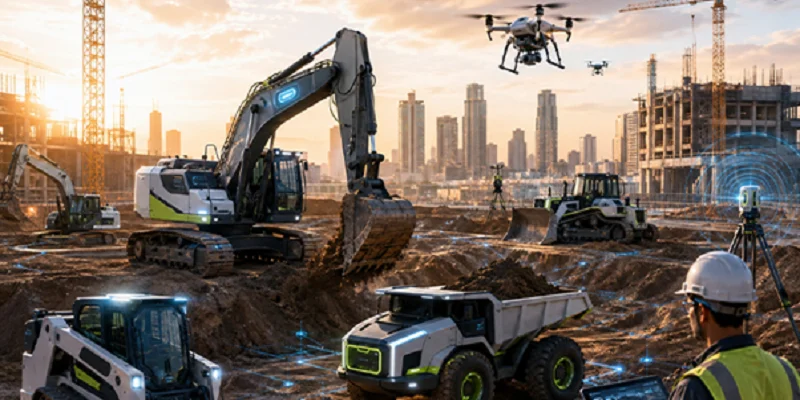
The construction industry is quietly rewriting how it builds. Diesel engines are giving way to battery packs, operators are supervising machines instead of muscling them through every motion, and job sites are generating more data than most construction firms know what to do with.
This isn't a glimpse of some distant future. It's the construction industry in 2026, and it's moving faster than most people outside the trade realize. Construction equipment is going through its biggest transformation since hydraulics replaced cables, and three forces are driving it: automation, electrification, and connectivity. Together, they're reshaping how contractors bid jobs, how operators spend their days, and how owners think about total cost of ownership.
If you're trying to understand where the industry is headed — or you're deciding what to invest in next — here's a clear-eyed look at what's actually happening.
How Automation and Electrification Are Transforming Construction Machinery
The short answer: automation is removing repetitive, dangerous, and imprecise work from human hands, while electrification is cutting fuel costs, emissions, and noise. Combined with connectivity, these shifts are turning ordinary machines into data-generating assets that contractors can manage like a fleet of smart devices rather than a yard full of steel.
This matters because construction has historically been one of the least digitized major industries. Margins are thin, labor is scarce, and equipment downtime is expensive. Automation and electrification aren't just nice-to-have upgrades — they're becoming the difference between a profitable bid and a losing one.
Construction Equipment Automation Is No Longer Experimental
A decade ago, construction equipment automation meant GPS-guided grading on a handful of flagship projects. Today it's standard on many mid-size jobs.
Modern automated construction equipment includes:
- Semi-autonomous excavators and dozers that use grade control to cut and fill to exact specifications without an operator constantly adjusting the blade.
- Autonomous haul trucks, already common in mining, now appearing on large civil projects moving earth between cut and fill zones.
- Robotic total stations and drones that survey a site in hours instead of days, feeding data directly into machine control systems.
- Compaction rollers with automated pass-count and stiffness monitoring, ensuring specs are met without guesswork.
The appeal is straightforward. Skilled operators are hard to find and expensive to train, and automation lets a single experienced operator supervise several semi-autonomous machines at once instead of running one machine at a time. It also reduces rework — a machine following digital grade data doesn't drift the way a tired operator might on hour ten of a shift.
None of this means fully driverless job sites are around the corner. Most automation today is "operator-assisted," where the machine handles precision tasks while a human still makes judgment calls. Full autonomy is progressing fastest in controlled, repetitive environments like quarries and large earthmoving projects, where the terrain is predictable and the risk of unexpected obstacles is lower.
Electric Construction Machinery Is Moving From Niche to Mainstream
Electric construction machinery has gone from a sustainability talking point to a genuine purchasing decision for fleet managers. The reasons aren't purely environmental — they're financial and operational.
Electric mini-excavators, compact wheel loaders, and skid steers now compete directly with their diesel counterparts on smaller job sites, especially indoor demolition, urban construction, and noise-sensitive areas like hospitals or residential neighborhoods near work zones. Electric machines produce zero tailpipe emissions, run significantly quieter, and have fewer moving parts to maintain — no oil changes, no diesel particulate filters, no regeneration cycles to manage.
The economics are improving too. While the upfront purchase price of electric equipment is still typically higher than diesel, total cost of ownership is closing the gap fast:
- Electricity generally costs less per operating hour than diesel fuel.
- Maintenance costs drop because electric drivetrains have far fewer wear components.
- Many cities and states offer incentives or tax credits for zero-emission construction equipment, particularly for projects tied to public contracts with emissions requirements.
The main obstacle is still charging infrastructure and runtime on larger machines. A compact electric excavator can comfortably run a full shift on a charge; a full-size electric dozer or crawler crane is a harder engineering problem, and battery weight and cost scale up quickly with machine size. That's why the current wave of electrification is concentrated in compact and mid-size equipment, with hybrid diesel-electric systems bridging the gap for larger machines until battery density and fast-charging infrastructure catch up.
Connected Construction Machinery: The Quiet Revolution
If automation and electrification are the visible trends, connected construction machinery is the one working in the background — and arguably having the biggest impact on fleet economics.
Telematics systems built into modern equipment now track:
- Real-time location and utilization across a fleet
- Fuel or battery consumption patterns
- Engine and hydraulic system health, flagging issues before they become breakdowns
- Idle time, which on many fleets accounts for a surprising share of operating hours and wasted fuel
This connectivity turns maintenance from a reactive scramble into a predictable schedule. Instead of waiting for a hydraulic pump to fail mid-project, a fleet manager gets an alert weeks in advance based on pressure and temperature trends, and can schedule the repair during planned downtime.
Connectivity also feeds directly into automation. A machine that reports its exact position, load, and performance in real time is a machine that can eventually be coordinated with other machines, dispatched more efficiently, and integrated into a broader digital twin of the job site. Some large contractors already run dashboards that show every piece of equipment across multiple sites, comparing utilization rates and reallocating idle machines to busier projects — something that was practically impossible to do accurately just a few years ago.
What "Smart Machinery" Actually Means on a Job Site
The term smart machinery gets used loosely, so it's worth being specific. Smart construction machinery typically combines three layers:
- Sensing — cameras, LiDAR, GPS, and load sensors that give the machine awareness of its surroundings and its own performance.
- Processing — onboard computing that interprets that data in real time, whether for collision avoidance, grade control, or predictive maintenance alerts.
- Communication — connectivity that shares that data with fleet management platforms, other machines, or the broader site plan.
The practical result is machinery that does more than just move earth or lift materials. A smart excavator can warn an operator about a nearby worker or utility line. A smart crane can calculate load sway and adjust in real time to prevent a swinging load from becoming a safety hazard. A smart compactor can confirm, on the spot, that a section of road base has hit spec — no separate testing crew required.
This is where automation, electrification, and connectivity genuinely converge. An electric machine is easier to instrument with sensors because it already has a sophisticated electronic control system managing the battery and motors. A connected machine is easier to automate because the data needed for autonomous decision-making is already flowing. The three trends reinforce each other rather than developing separately.
Construction Machinery Trends in Automation and Electrification: What to Watch Next
Looking ahead, a few developments are worth tracking closely:
- Hydrogen fuel cells are being piloted for larger equipment where battery weight is impractical, potentially solving the runtime problem for full-size machines.
- Interoperability standards are emerging so machines from different manufacturers can share data on the same job site platform, reducing the "walled garden" problem that's slowed fleet-wide automation.
- AI-assisted site planning is starting to combine drone survey data, weather forecasts, and equipment telematics to automatically sequence which machines go where and when.
- Retrofit kits are making it possible to add automation and connectivity features to existing diesel equipment, which matters enormously for contractors who can't afford to replace an entire fleet overnight.
The Bottom Line
The construction industry has always been shaped by heavy iron and hard labor, but the machines themselves are getting smarter, cleaner, and more self-sufficient. Automation is reducing the burden on skilled operators and improving precision. Electrification is cutting fuel and maintenance costs while opening up job sites that were previously off-limits to diesel equipment. And connectivity is turning every machine into a source of data that makes the entire fleet run more efficiently.
None of these trends are replacing the people who run construction projects — they're giving them better tools to do it. Contractors who start adapting now, even with a handful of electric or automated machines mixed into a traditional fleet, are the ones best positioned to handle the labor shortages, emissions regulations, and cost pressures already shaping the next decade of construction.
The job site of the future isn't fully robotic and it isn't fully electric yet — but it's clearly headed that way, one machine at a time.
 Our Services
 Media Pack Download
 Newsletters
 Industrial Events