Cloud & Digital Factory Services: The Backbone of Modern Industrial Automation
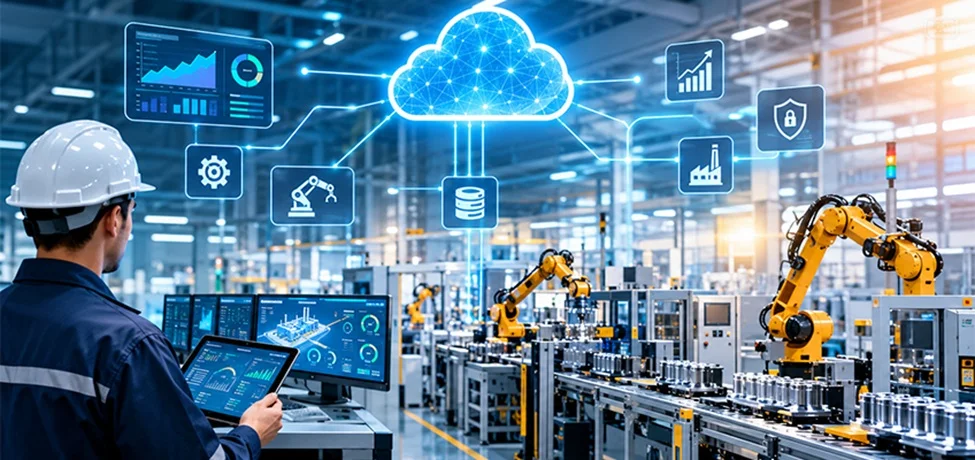
Most factories aren’t short on data. They’re short on data they can actually use.
Every machine on your floor is already producing signals: temperature, vibration, cycle times, fault codes. But if that information is trapped in separate PLCs, local PCs and paper logs, it might as well not exist. Teams end up guessing why a line stopped, why quality dipped or why one plant outperforms another. This gap between having data and using data is what digital factory services are built to close.
Quick answer: Digital factory services are the cloud platforms, connectivity tools, analytics and integration work that link machines, systems and people into one real-time view of production. They are the backbone of modern industrial automation because they turn isolated equipment into a connected, data-driven operation.
What Are Digital Factory Services?
Think of a factory as a body. The machines are the muscles, the PLCs and sensors are the nerves, and digital factory services are the brain and circulatory system. They collect signals, make sense of them and send decisions back to where they’re needed.
In practice, they usually cover:
- Connectivity: getting data out of PLCs, SCADA, CNC machines and legacy equipment
- Data platforms: storing and organizing that data in the cloud or at the edge
- Analytics and AI: spotting patterns, predicting failures, optimizing output
- Integration: linking shop-floor data with ERP, MES, quality and supply chain systems
- Security and governance: protecting operations without slowing them down
When these pieces work together, you get what the industry calls smart factory digital services: a plant that sees itself clearly and responds quickly.
Why Is the Cloud Now Central to Industrial Automation?
For years, automation meant control systems that ran locally and rarely talked to anything else. That worked until the questions got harder. Why is Plant A 12% less efficient than Plant B? Which machine will fail next month? Can we trace this defect back to a raw material batch?
Local systems can’t answer these. Industrial cloud services can, because they bring data from many machines, lines and sites into one place where it can be compared, analyzed and acted on.
Cloud-based industrial automation doesn’t replace real-time control on the floor. Fast, safety-critical decisions still happen at the edge, close to the machine. The cloud handles what it’s best at: heavy analytics, long-term storage, multi-site visibility and rapid scaling.
What Is Industrial Cloud Computing, really?
Industrial cloud computing means running manufacturing workloads, such as data collection, analytics, applications and AI models, on cloud infrastructure built for operational technology (OT), not just office IT.
It differs from ordinary business cloud in a few important ways:
| Factor | Standard Business Cloud | Industrial Cloud Computing |
| Data type | Documents, transactions | Machine signals, time-series, sensor data |
| Latency needs | Seconds are fine | Milliseconds can matter (often paired with edge) |
| Connectivity | Web and apps | PLCs, OPC UA, MQTT, legacy protocols |
| Downtime tolerance | Moderate | Very low |
| Security focus | Data privacy | Data privacy plus physical process safety |
Most real deployments are hybrid: edge devices on the floor handle instant decisions, while the cloud handles scale and intelligence.
What Do Cloud Services for Industrial Automation Actually Deliver?
Skip the buzzwords. Here’s what manufacturers typically get from cloud services for industrial automation:
1. Real-time visibility. Live dashboards show OEE, downtime, scrap and energy use across lines and plants, so managers stop chasing spreadsheets.
2. Predictive maintenance. Instead of fixing machines after they break, or servicing them too early “just in case,” models flag unusual vibration, temperature or current patterns before failure.
3. Faster root-cause analysis. When quality drifts, connected data lets teams trace the cause across machine settings, materials and shifts in minutes rather than days.
4. Easier scaling. Rolling a proven solution to a new plant becomes a configuration task rather than a ground-up project.
5. Better decisions, sooner. Planners work from live shop-floor data instead of last week’s report.
These benefits are why Cloud-Connected Smart Factory Solutions are moving from pilot projects to core strategy.
Digital Factory Solutions: What Does a Modern Stack Look Like?
You don’t need to buy everything at once. A practical digital factory solutions stack has four layers:
1. Shop-floor layer: machines, sensors, PLCs, edge gateways
2. Connectivity layer: industrial protocols (OPC UA, MQTT, Modbus) that normalize data
3. Cloud platform layer: storage, data models, analytics, AI/ML services
4. Application layer: dashboards, predictive maintenance, quality, energy and traceability apps
A common mistake is starting at layer four, with fancy dashboards, before layers one and two are solid. Dashboards built on messy, unreliable data just show you confusing information faster.
How Do Industrial Cloud Solutions Support Digital Transformation?
Industrial cloud solutions for digital transformation work best when they’re tied to a business problem rather than a technology wish list. The manufacturers who succeed usually pick one painful problem first, such as unplanned downtime, scrap, energy cost or slow changeovers, and build outward from there.
Real Industrial Digital Transformation Services typically include:
- Assessment: mapping current systems, data gaps and quick wins
- Roadmap: deciding what to connect first, and why
- Pilot: proving value on one line or one machine group
- Scale-up: standardizing and rolling out across plants
- Change management: training operators and engineers, which is often the part that decides success or failure
That last point deserves emphasis. Technology rarely fails on its own. It fails when the people who run the machines weren’t involved, don’t trust the data or don’t see what’s in it for them.
What Are the Biggest Challenges (and How Do You Handle Them)?
Legacy equipment. A 20-year-old machine can still be connected. Retrofit sensors and protocol gateways make it possible without replacing the asset.
Cybersecurity. Connecting OT to the cloud widens the attack surface. Use network segmentation, role-based access, encryption and continuous monitoring from day one, not as an afterthought.
Data quality. Inconsistent tag names, missing timestamps and unlabeled data can make analytics useless. Invest early in a clean, standardized data model.
Skills gap. Few teams have deep expertise in both OT and cloud. Partnering with specialists, or upskilling a small cross-functional team, closes the gap faster than hiring alone.
Unclear ROI. Define a baseline metric before you start, such as hours of downtime or percent scrap, so improvement is measurable.
A Simple Starting Plan for Your Factory
If you’re wondering where to begin, here’s a realistic path:
1. Choose one problem that costs real money (downtime is usually a good one).
2. Connect the relevant machines and collect clean data for 4 to 8 weeks.
3. Visualize and validate with the operators who know the machine best.
4. Add analytics such as alerts, trend detection or predictive models.
5. Measure the result against your baseline.
6. Replicate to similar lines or sites.
Small, proven steps build the internal trust that large transformation programs need.
The Bottom Line
The factories pulling ahead aren’t necessarily the ones with the newest machines. They’re the ones that understand their own operations in real time. Digital factory services and industrial cloud services make that possible by connecting equipment, data and people into one coordinated system.
You don’t need to transform everything overnight. Start with one line, one problem and one clear metric. Prove it, then grow it.
Frequently Asked Questions
What are digital factory services?
They are cloud, connectivity, analytics and integration services that connect machines, systems and people in a factory to improve visibility, efficiency and decision-making.
What is the difference between industrial cloud and regular cloud?
Industrial cloud is designed for manufacturing data such as sensor streams and machine signals, supports industrial protocols and meets stricter uptime and security needs.
Does cloud-based industrial automation replace PLCs or SCADA?
No. Real-time control stays local. The cloud adds analytics, storage, multi-site visibility and scalability on top of existing control systems.
Can older machines be part of a smart factory?
Yes. Retrofit sensors, edge gateways and protocol converters can connect legacy equipment to cloud platforms.
How long does industrial digital transformation take?
A focused pilot can show results in a few months. Full multi-plant rollouts typically take longer, depending on scale and complexity.
Is cloud-connected manufacturing secure?
It can be, with network segmentation, encryption, access controls and continuous monitoring built into the architecture from the start.
 Our Services
 Media Pack Download
 Newsletters
 Industrial Events