Cloud vs. Edge Computing: Choosing the Right Solution for Manufacturing

Introduction
Today’s technologies are rapidly evolving making it easier for industries to adapt to better manufacturing through various advanced tools. Amongst these innovations, Cloud computing and Edge computing has grown into two revolutionary technologies. Each has its advantages, but how does one choose the best that will suit a manufacturing company? In the following guide, you will learn about its uses, advantages, and potential disadvantages of adopting cloud and edge computing.
Cloud Computing for Manufacturing
What Is Cloud Computing?
It is possible to describe cloud computing as a capability that enables a firm to tap into the internet in order to use computer resources that would have ordinarily been contained within the firm’s computing systems. Rather than solely connecting and supporting preeminent systems used for production, company can place data in the cloud-based solutions.
Applications of Cloud Computing in Manufacturing
1. Remote Data Storage:
Enormous data relating to production and operation can be collected and there’s no need to invest in expensive servers that are required for the storage of data.
2. Cloud-Based Manufacturing Systems:
Software as a Service (SaaS) applications provide ways for manufacturers to control production schedules, supply chain activities, and many maintenance procedures online.
3. Cloud Analytics:
Manufacturers can also harness advanced analytics tools in the cloud to derive more insight to help eliminate waste.
4. Centralized Data Management:
Cloud technology helps to keep information from different manufacturing units and the information is also available on-demand.
Benefits of Cloud Computing in Manufacturing
• Scalability: Easy to scale and can be done in a small batch or large batch depending on the present production needs.
• Cost Efficiency: This approach means that an organization pays only for the taken resources hence minimizing capital spending.
• Global Collaboration: Remote working groups can be aware of the information that is available and share information among the team.
Edge Computing’s Role in Manufacturing
What Is Edge Computing?
Edge computing signifies data processing to its source, like IoT devices, factory equipment instead of centralized cloud servers. This decentralization brings about lower latencies and enhance real-time decisions.
Applications of Edge Computing in Manufacturing
a. Real-Time Processing:
With the help of edge computing, data received from sensors and IoT devices, can be processed immediately with the further ability to quickly make some changes in the production process.
b. Industrial IoT and Edge Devices:
Some of the subsets of Internet of Things include: sensors, cameras, and IoT devices collect data, perform computations, and make decisions at the edge, increasing automation and enabling predictive maintenance.
c. Decentralized Manufacturing Systems:
One edge solution is to spread computational processes in order to lessen dependence on one server, as well as increase the level of system stability in case of failures.
Benefits of Edge Computing in Manufacturing
• Reduced Latency: It puts it in a position to counter occurrences/issues on the shop floor faster.
• Enhanced Security: Local data processing is relatively safer from external acts of cyberspace vandals.
• Reliability: They can proceed normally, which is critical during internet disruptions or discontinuity of cloud connection.
Cloud vs. Edge: Key Differences
| Feature | Cloud Computing | Edge Computing |
| Data Processing | Centralized in remote servers | Decentralized at the edge (near data source) |
| Latency | Higher latency due to network delays | Minimal latency for real-time processing |
| Scalability | Highly scalable for large-scale operations | Limited by edge device capacity |
| Cost | Pay-as-you-go model; potential higher network costs | Initial setup cost for edge devices; low ongoing costs |
| Security | Data is vulnerable during transmission over networks | Local processing enhances security |
| Use Case Examples |
Predictive analytics, global collaboration |
Real-time quality control, predictive maintenance |
Choosing the Right Solution: Cloud or Edge?
If you are in the manufacturing sector, you need to decide between cloud and edge computing for your operations
When to Choose Cloud Computing
• You need global data availability and data sharing solutions
• Your operations demand sophisticated analysis that cannot be conducted by routine or low powered machines.
• It is cost efficient, can be scaled up or down as needed and doesn’t get in the way of doing business
When to Choose Edge Computing
• Its functions require constant data processing at the shortest time possible, or delay at the least
• You work or travel to areas with poor and unreliable internet connection
• With concerns to security, the data must remain within the locality’s jurisdiction.res faster responses to issues on the factory floor.
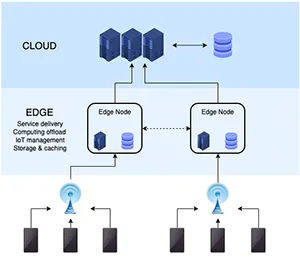
Hybrid Solutions: The Best of Both Worlds
This has led to the integration of both computing paradigms, where many manufacturers are already implementing a more enhanced solution that combines cloud and edge computing. For example:
• Edge devices handle real-time processing on the factory floor.
• Cloud systems store and analyze historical data for long-term insights.
Benefits of a Right Edge-to-Cloud Strategy
1. Enhanced Operational Efficiency:
There is real-time optimization at the edge, and cloud is for long-term optimization guidance.
2. Improved Decision-Making:
The solutions at the edge and in the cloud allow preliminary and, at the same time, strategic decisions fueled by data.
3. Cost Savings:
Eliminate the need for network utilization and cloud data consumption by performing analyses only on the vital data at the edge.
Performance: Cloud vs. Edge
Real-Time Processing
In decision making, edge computing is most effective when it comes to solutions that must be delivered almost instantly, as with identification of defects in assembly lines. Cloud computing, though less effective, is preferable for work such as predictive maintenance and sales demand forecasting.
Industrial IoT Integration
Cloud computing and edge computing is important in the development of the Industrial Internet of Things (IIoT). Cloud systems manage the complicated process of big data analysis and edge computing maintaining communication between connected devices.
Challenges and Considerations:
| Challenge | Cloud Computing | Edge Computing |
| Infrastructure Cost | Low initial cost but higher ongoing costs due to data transfer | High setup cost for edge devices |
| Skill Requirements | Requires IT expertise for cloud migration | Requires specialized knowledge of edge devices |
| Data Storage | Relies on third-party providers |
Limited by local device capacity |
Trends Shaping the Future of Manufacturing Computing
a. Industrial IoT Growth:
The increasing deployment of IoT devices in smart factories is applying pressure to incorporate edge computing.
b. AI and Machine Learning:
Advanced AI Models are hosted in the cloud while practical applications of AI through edge computing happen in the field.
c. Decentralized Systems:
Regarding the tendency toward the decentralization of manufacturing systems, edge computing provides a suitable solution.
Practical Tips for Implementation
Assess Your Needs:
Plan your latency, data security, and scalability needs and do adequate research on your manufacturing needs.
Start Small:
Launch your cloud or edge solution in one factory and then extend it to other factories.
Invest in Training:
Enable your team to be proficient in management of Cloud and edge computing systems.
Collaborate with Experts:
Talk to technology providers for developing a suitable solution.
Conclusion:
Cloud and edge computing are two different solutions but they offer the same services and provide a synergy to each other. Although cloud computing provides centralized data control and flexibility for data storage, edge computing provides the required speed for manufacturing systems. Hence, the understanding of each of them can allow manufacturers to develop the right edge-to-cloud business model for efficiency, cost-control and survival in this period of industrial transformation.
 Our Services
 Media Pack Download
 Newsletters
 Industrial Events