Additive Manufacturing in Automation: Applications, Benefits & ROI
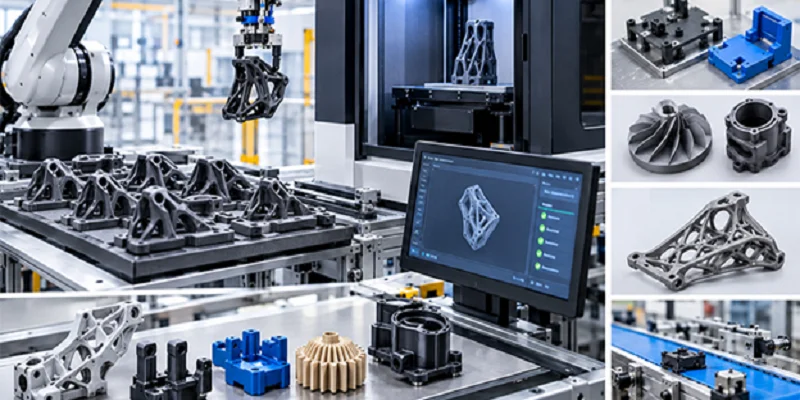
Quick answer: Additive manufacturing in automation means combining industrial 3D printing with robotics, software and connected workflows so parts are designed, printed, finished and moved with minimal manual effort. Factories use it to make tooling, spare parts and complex components faster and cheaper, and many see payback within 6 to 24 months, depending on volume and use case.
If you run a factory, you've probably heard "3D printing will change everything" for ten years. Fair enough if you're skeptical. For a long time, 3D printing meant prototypes, a messy workbench and a lot of waiting.
That has changed. Today, industrial additive manufacturing is a serious production tool, and when you automate it, it starts to look a lot like a real manufacturing line. This guide covers what additive manufacturing in automation is, where it works best, what it delivers, and how to work out whether it will pay off for you.
What Is Additive Manufacturing in Automation?
Additive manufacturing builds parts layer by layer from a digital file, using plastics, metals, composites or resins. Unlike machining, which cuts material away, it adds material only where needed.
Additive manufacturing in automation takes this a step further. Instead of an operator loading files, starting prints, removing parts and cleaning them by hand, the process is connected end to end:
- Software queues and schedules print jobs automatically
- Robots or conveyors load build plates and remove finished parts
- Sensors monitor quality during the build
- Post-processing (depowdering, support removal, surface finishing) is partly or fully automated
- Data flows into your ERP or MES system
Think of it as moving from a single 3D printer in the corner to a 3D printing automation cell that runs more like a CNC machining center: set it up, load the queue, walk away.
Additive Manufacturing vs. Traditional Manufacturing Automation
Traditional manufacturing automation (robotic arms, CNC machines, injection molding lines) is excellent at high-volume, repeatable work. Its weakness is flexibility. Changing a design means new tooling, new programming and often weeks of delay.
Additive manufacturing flips that:

The two aren't rivals. The smartest factories use additive to cover what conventional automation does poorly: custom parts, fast changes and complex designs.
Top Additive Manufacturing Applications in Automation
Here are the additive manufacturing applications delivering results on factory floors today.
1. Custom robotic end-of-arm tooling (EOAT)
Grippers and fingers for robots are usually one-off designs. Printing them lets you make lightweight, application-specific tools in a day instead of waiting weeks for machining. Lighter grippers also mean faster robot cycles and less wear.
2. Jigs, fixtures and assembly aids
This is often the easiest place to start. Printed jigs and fixtures are cheap, quick to modify and easy to replace. Many plants find they can create a new fixture overnight.
3. On-demand spare parts
Waiting for a discontinued part can halt a line for days. With additive manufacturing for factories, you keep a digital inventory instead of a physical one, and print the part when it's needed. That reduces warehouse space, capital tied up in stock and downtime.
4. Production of end-use parts
With metal and high-performance polymer printing, industrial 3D printing now makes final parts for aerospace, automotive, medical devices and energy equipment. Consolidated designs, where five parts become one, cut assembly steps and potential failure points.
5. Conveyor, packaging and machine components
Guides, brackets, housings, vacuum cups and sorting components can all be printed and tuned to your exact product.
6. Rapid prototyping inside automated lines
Engineers can test a new part on the actual line within hours, not weeks, which speeds up continuous improvement.
Key Benefits of Industrial Additive Manufacturing
Faster lead times
When there's no tooling to build, you go from CAD file to physical part in hours or days. For maintenance teams and engineers, that speed alone can justify the investment.
Lower costs on low-volume work
Traditional methods get cheaper per unit as volume rises. Additive manufacturing has almost no setup cost, so it wins on short runs, custom parts and "one-off" needs.
Design freedom
Internal channels, lattice structures and organic shapes that can't be machined are straightforward to print. This often yields lighter and stronger parts.
Less waste
Because material is added rather than removed, scrap is typically much lower than in subtractive methods, which matters most for expensive metals.
Supply chain resilience
Printing locally reduces dependence on distant suppliers and long shipping times. You control your own parts supply.
Reduced labor through automation
Here's where automated 3D printing pays off. Without automation, one person might tend a few machines. With automated build plate handling, remote monitoring and automated post-processing, the same team can run many more, and prints can run overnight and on weekends.
How to Calculate ROI for Additive Manufacturing
ROI is where many articles stay vague, so here's a practical framework.
Basic formula:
ROI (%) = (Annual Savings + Annual New Revenue − Annual Operating Cost) ÷ Total Investment × 100
Payback period = Total Investment ÷ Net Annual Benefit
Costs to include
- Printer(s) and automation hardware (robots, handling, post-processing)
- Software (design, slicing, workflow management)
- Materials
- Training and integration
- Maintenance and energy
- Facility needs (ventilation, powder handling for metals)
Savings and gains to include
- Avoided tooling and outsourcing costs
- Reduced downtime from faster spare parts
- Lower inventory and storage costs
- Labor hours saved through automation
- Faster time to market
- Revenue from new custom products or services
An illustrative example
(Numbers are hypothetical, for demonstration only.)
A mid-size plant spends ₹40 lakh a year outsourcing fixtures, grippers and spare parts, with an average wait of three weeks. It invests ₹60 lakh in an industrial polymer printing cell with basic automation. After the first year:
- Outsourcing drops by ₹28 lakh
- Downtime savings add ₹10 lakh
- Operating costs (materials, upkeep, labor) run ₹14 lakh
Net annual benefit = ₹28L + ₹10L − ₹14L = ₹24 lakh
Payback period = ₹60L ÷ ₹24L = 2.5 years
That's solid, but not magic. Increase the printer's utilization through automation, or add more applications like EOAT and production parts, and payback shortens quickly. Utilization is the biggest ROI lever. A printer sitting idle earns nothing; one running 20 hours a day, unattended, earns its keep.
Challenges to Plan For
Honest guidance builds trust, so here are the real hurdles:
- Upfront cost: Industrial metal systems can be expensive. Start with polymers if you're unsure.
- Skills gap: Design for additive manufacturing (DfAM) is different from traditional design. Training matters.
- Post-processing: Often the hidden bottleneck. Budget time and money for it.
- Material and certification limits: Regulated industries need qualified processes and materials.
- Not every part suits printing: High-volume, simple parts are usually still cheaper to mold or machine.
How to Get Started: A 5-Step Roadmap
- Audit your pain points. List parts with long lead times, high costs or frequent redesigns.
- Pick 3 to 5 pilot applications. Fixtures, grippers and spare parts are low-risk starters.
- Choose technology to match the job. Polymer processes for tooling, metal for end-use parts.
- Build automation in stages. Begin with job scheduling and remote monitoring, then add robotic part handling and automated finishing.
- Track the numbers from day one. Measure cost per part, lead time, uptime and utilization so your ROI case is proven, not guessed.
What's Next for Additive Manufacturing in Automation?
Expect AI-driven print monitoring that catches defects mid-build, tighter integration with robotics, and wider adoption of distributed manufacturing, where parts are printed near where they're needed. As machines get faster and materials improve, the line between "prototyping tool" and "production machine" will keep fading.
Frequently Asked Questions
What is additive manufacturing in automation?
It's the integration of industrial 3D printing with robotics, software and sensors so that printing, part handling and finishing run with minimal human input.
What are the main additive manufacturing applications in automation?
Robotic gripper tooling, jigs and fixtures, on-demand spare parts, machine components, end-use production parts and rapid prototyping on active lines.
Is industrial 3D printing cost-effective for factories?
Yes for low-to-medium volumes, custom parts and fast-turnaround needs. For very high volumes of simple parts, traditional methods usually remain cheaper.
How long does it take to see ROI?
It varies by application and utilization. Many factories target 6 to 24 months for tooling and spare-parts use cases, while larger metal systems take longer.
Can 3D printing be fully automated?
Mostly, yes. Job scheduling, part removal and monitoring can be automated today. Some post-processing steps still need manual work, though this is improving.
What's the difference between 3D printing and additive manufacturing?
They describe the same core technology. "3D printing" is the common term, while "additive manufacturing" is typically used for industrial, production-grade applications.
Final Thoughts
Additive manufacturing in automation isn't about replacing your existing lines. It's about filling the gaps where conventional methods are slow, rigid or expensive. Start small, automate in stages, measure everything, and let the ROI numbers guide your next step.
 Our Services
 Media Pack Download
 Newsletters
 Industrial Events