

Robotiq

About: Samuel Bouchard - CEO and co-founder
Samuel Bouchard is CEO and co-founder of Robotiq. His mission is to free human hands from repetitive tasks. Samuel is also the author of Lean Robotics: A Guide to Making Robots Work in Your Factory. He lives in Québec City.
Abstract:
The Lean Palletizing Experience offers manufacturers a structured, five-step path to automation: Select, Simulate, See, Start, and Scale. This Q&A article answers key questions and shows how this approach reduces uncertainty, accelerates deployment, and provides a clear, adaptable framework for collaborative palletizing.
1. Can you explain the critical criteria manufacturers should consider during the Select phase to ensure the chosen automation solution aligns with production goals?
The Lean Palletizing Experience is a 5-step approach taking manufacturers on a digital-to-physical journey from online validation and design to physical end-of-line productivity. “Select” is the first step in the Lean Palletizing Experience. The next steps are Simulate, See, Start, and finally, Scale.
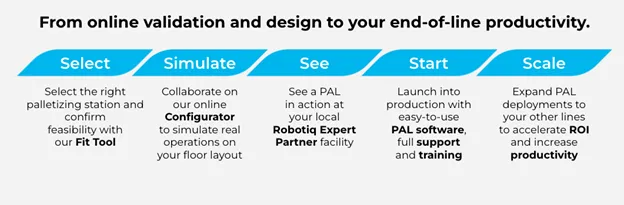
At the Select phase, the key is to keep it simple. Manufacturers should select the simplest palletizing station in their factory to accelerate the first deployment, get hands-on experience, and start seeing a return on investment. A solution has to match your current production goals but also have room for growth.
Too often, companies either over-spec or under-spec their first palletizer. The Palletizing Fit Tool was created to make this step faster and easier - it uses your real production data to tell you, within minutes, whether a solution is viable and which setup is right for your factory. That gives you a clear, data-driven starting point. You’ll also receive a 3D simulation tailored to your factory requirements, a detailed ROI, price range, and payback period calculation.
2. How do you evaluate whether a collaborative robot or a traditional palletizing
system is optimal for a specific production environment?
Choosing between a collaborative palletizer and a traditional high-speed system comes down to three factors: safety, throughput, and footprint. Collaborative systems are best when flexibility and safe operator interaction are key, or when floor space is limited. Traditional systems remain a fit for extremely high-volume, high-speed lines.
The most effective way to decide is to run the numbers. For example, one mid-sized food manufacturer recently compared both options and found that a collaborative palletizer met their throughput needs while cutting installation time in half and reducing floor space requirements. The lesson is clear: the “best” solution isn’t universal — it’s the one that matches your factory’s goals and constraints.
3. In the Simulate step, what are the most common challenges when modeling
palletizing processes, and how can they be mitigated?
One challenge is modeling the exact product flow and box presentation. If you simplify too much, your simulation may look perfect but fail in reality. Our Online Configurator takes the guesswork out of 3D simulation by allowing you to input data about the products you are palletizing as well as your physical setup (such as low ceilings or obstacles on your factory floor).
4. How does digital simulation help reduce uncertainty in automation deployment,
and what metrics should be monitored during this phase?
Simulation lets you test your design before you spend a dollar on hardware. It lets you verify that the robot can reach every pick and place position, that your cycle time meets production needs, and that your pallet patterns are stable - all before you order a single piece of equipment.
You can verify reach, cycle time, and pallet patterns virtually. Some key metrics to monitor are throughput and cycle time.
5. The See step emphasizes visualization - how can manufacturers leverage this
phase to detect inefficiencies before implementation?
Seeing a live palletizing system in action is invaluable. In the See step, manufacturers should visit a local Robotiq partner to check out the palletizer in real life. This is the phase of the Lean Palletizing Experience where the user moves from the digital portion to the physical part of the automation journey. They can even test the equipment with their own products to ensure efficiency.
6. Could you provide examples of key insights that real-time observation might
reveal which simulations might be overlooked?
Overall, our Online Configurator takes into account the parameters needed to test a specific setup at a specific factory. But even the best simulations can’t capture everything. Live observation often reveals practical issues: how boxes feed into the system, how operators interact with the cell, or how pallets move downstream. These details can make the difference between a smooth launch and unexpected bottlenecks.
7. What strategies do you recommend for a smooth transition from pilot to full-scale operation during the Start phase?
A smooth transition starts with treating the pilot as a blueprint, not a one-off. Standardize software, training, and cell design so lessons carry into the next deployment. Manufacturers who do this find that adding new cells is faster and less costly, since the same programs and skills apply. With scalability built in, moving from one line to many becomes almost plug-and-play.
8. How can manufacturers maintain production continuity while integrating a new
collaborative palletizing system?
Production continuity depends on reducing uncertainty before installation. The Lean Palletizing Experience is built around this idea: by validating and simulating the solution digitally first, manufacturers can confirm reach, cycle times, and layouts before any hardware arrives on site.
This preparation dramatically lowers the risk of surprises during integration. When it comes time to install, the system is already proven in a virtual environment, which means downtime is minimized and production can resume quickly.
9. In your experience, what are the most common mistakes companies make when
moving from simulation to actual deployment?
One mistake is underestimating operator training. Even with easy-to-use software, your team needs time to get comfortable and build confidence. Robotiq and its partner’s offer training as part of the installation process so that the team is ready to go as soon as the palletizer is up and running.
Another pitfall is ignoring change management - involving operators early creates buy-in and smooth the transition.
10. Scaling automation often comes with hidden costs - how should manufacturers
plan for capacity, workforce, and system adaptability?
Hidden costs often come from redesigning layouts, retraining teams, or adding custom integrations later. A modular approach prevents this by letting you reuse the same software, interface, and building blocks as you grow. You should plan for growth from day one and plan on reusing the same software, components, and training when you add a second cell or expand to a new site.
11. How can the Lean Palletizing framework ensure scalability without compromising
efficiency or flexibility?
The Lean Palletizing Experience was designed to be repeatable. Because it’s standardized, every deployment builds on the last. You’re not reinventing the wheel each time you add a cell. Whether you add one cell or ten, you’re working with the same architecture. This keeps deployments consistent, predictable, and cost-effective.
12. How does the five-step approach specifically reduce uncertainty compared to
traditional automation rollout methods?
Traditional automation projects can feel like a leap of faith - you only see the results after installation. The Lean Palletizing Experience offers a five-step process that builds confidence at each stage, so there are no surprises on launch day.
You validate digitally, you simulate, you see it live, you start small, and then you scale. This tried and true process gives decision-makers confidence in their investment.
13. How can this framework be adapted for facilities with multiple product lines or
high SKU variability?
Robotiq’s interface allows fast recipe changes and SKU additions without deep programming knowledge. That makes it easy to handle multiple lines or seasonal product changes without engineering delays. That kind of flexibility used to be a luxury; now it’s a necessity.