

PLC vs. PAC: Which Controller Is Right for Your Automation Application?
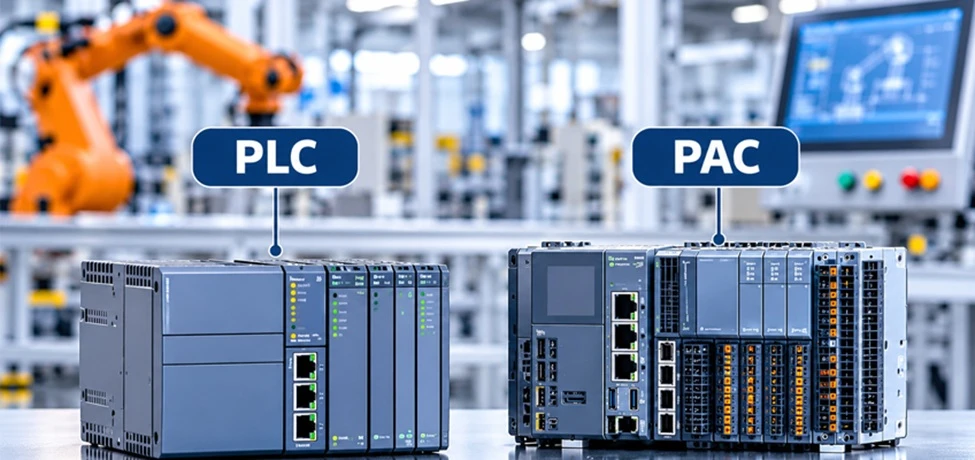
The debate over these two controller types has outlived its usefulness. The question that matters is what your machine actually needs to do.
Controller selection is one of the few automation decisions that is easy to get wrong and expensive to reverse. Buy too little and the system hits its limits within a year. Buy too much and the plant pays for processing power, licences and training that never earn a return. The PLC and the PAC are usually framed as rivals. In practice, they are two points on a spectrum, and the line between them has been moving for twenty years.
A Short History That Explains a Lot
The programmable logic controller arrived in the late 1960s to replace racks of hard-wired relays. Its job was narrow and it did that job well: read inputs, run logic, update outputs, repeat. Ladder logic was chosen because it looked like the electrical drawings technicians already understood.
The term PAC came much later. ARC Advisory Group introduced it in the early 2000s to describe controllers that did more than classic PLCs: more memory, faster processors, open communications and the ability to handle motion, process control and data on a single platform.
Part of the difference between the two is real engineering. Part of it is positioning. Any honest comparison has to hold both ideas at once.
Where the PLC Still Wins
For discrete, sequence-driven work, the PLC remains hard to beat. A bottling line, a palletiser, a pump station or a conveyor with a few dozen interlocks does not need a supercomputer. It needs fast, predictable scans and logic that a maintenance technician can read at three in the morning with a laptop and little else.
That last point is undervalued. A controller your own team can diagnose without calling the integrator saves money every time something stops. Add shared spares and shared knowledge across a fleet of similar machines, and the PLC’s advantage in simple applications becomes substantial.
Where the PAC Earns Its Premium
The PAC makes its case when requirements stack up. A robotic cell may need coordinated servo axes, vision, safety functions and conveyor logic running together. A process skid may need recipe management and batch records. A test stand may need to log high-speed data to a database while it controls the test.
On a PLC platform, these demands often mean extra hardware: a separate motion controller, a gateway, perhaps an industrial PC alongside the controller. A PAC typically absorbs the work in one environment, with a single tag database and support for several IEC 61131-3 languages. Structured text matters most here, because calculation-heavy logic written in ladder becomes difficult to read and harder to maintain.
The Comparison in Brief
|
PLC |
PAC |
|
|
Typical role |
Discrete machine and line control |
Mixed motion, process and data control |
|
Main language |
Ladder logic |
Ladder, structured text, function blocks |
|
Processing and memory |
Modest, tuned for fast scans |
Larger, built for multitasking |
|
Connectivity |
Standard fieldbus and Ethernet |
Often adds OPC UA, MQTT, SQL links |
|
Upfront cost |
Lower |
Higher |
|
Skills required |
Core controls knowledge |
Broader: networking, data, structured code |
This table describes tendencies, not rules. Plenty of current PLCs tick boxes in the right-hand column.
The Label Has Stopped Meaning Much
Modern high-end PLCs ship with integrated motion, embedded web servers and OPC UA support. Some products marketed as PACs are, in effect, top-tier PLCs with a new name. Vendors apply the terms inconsistently, and buyers who shop by label are shopping blind.
The sensible approach is to specify by capability. Look at scan time under realistic load, available memory, supported languages, network options and motion performance. Then check the unglamorous details: whether your drives, HMIs and software licences work with the platform, and whether the supplier has a credible long-term roadmap.
Cost Is Not the Sticker Price
The PLC is cheaper to buy. Stopping the analysis there is the usual mistake.
In a complex system, a PAC can come out cheaper overall if it replaces a PLC, a motion controller and a data gateway. In a simple machine, it will almost always cost more for features that stay switched off.
Engineering time, software licences, training, spares and vendor support all belong in the calculation. So does lifespan. Controllers routinely stay in service for fifteen years or more, which means a discontinued product line can cause problems long after the purchase order is forgotten.
How to Decide
A scoring matrix is unnecessary. A few honest questions settle most cases:
1. Is the control mainly discrete sequencing? Start with a PLC.
2. Does the machine need motion, process control and data handling together? Start with a PAC.
3. Must the controller talk directly to databases, an MES or cloud systems? That leans toward a PAC.
4. Can the maintenance team support the platform? If not, budget for training before committing.
When the answers split evenly, shortlist one controller from each category and compare complete quotes, including software and support, rather than hardware prices alone.
The Verdict
Neither controller deserves a blanket recommendation. The PLC remains the sensible, economical choice for straightforward machine control. The PAC is justified when an application combines disciplines or demands serious data handling.
The better habit is to ignore the category and write down what the machine must do over the next decade. Buy the headroom you expect to use, and no more. Make sure the people who will keep the system running are comfortable with the choice. A controller that suits the plant’s people and processes will outperform a more impressive one that does not.
 Our Services
 Media Pack Download
 Newsletters
 Industrial Events
Thank you!
Client Success Team (CRM),
