Introduction
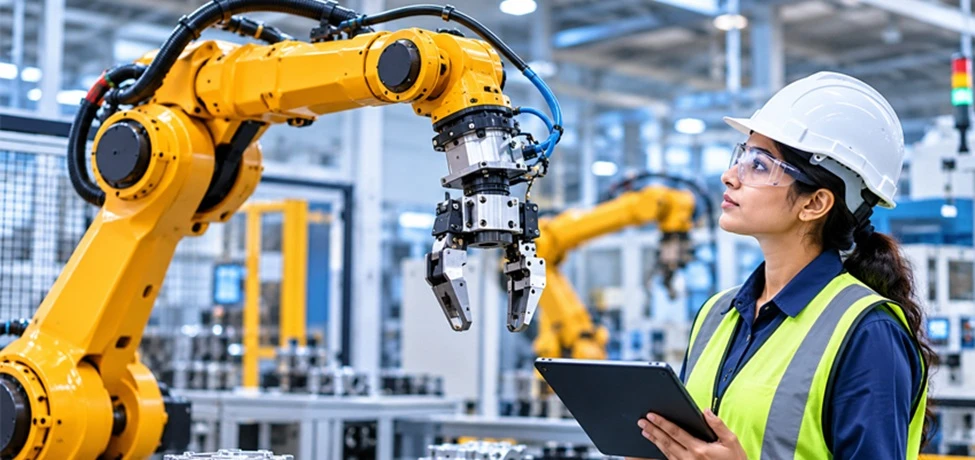
Industrial robots have become an important part of modern manufacturing, helping businesses automate repetitive tasks, improve production consistency and manage operations that require speed, precision or continuous handling. From automotive assembly lines and electronics manufacturing to food processing, packaging and material handling, robots are being deployed across a growing range of industrial applications.
However, selecting an industrial robot involves more than comparing payload capacities, operating speeds or purchase prices. A robot that performs well in one application may not be suitable for another. Factors such as the type of operation, workpiece dimensions, required accuracy, available floor space, operating environment and integration requirements all influence the selection process.
The right investment should address an actual production requirement while allowing room for future operational changes. This guide explains the key considerations businesses should evaluate when choosing an industrial robot, helping buyers compare available options and make informed purchasing decisions.
Table of Contents
1. Before You Start
2. Define Your Application
3. Understand the Available Types
4. Evaluate Technical Specifications
5. Assess Performance Requirements
6. Consider the Operating Environment
7. Check Safety and Compliance
8. Evaluate Integration and Compatibility
9. Consider Maintenance and Support
10. Calculate the Total Cost of Ownership
11. Questions to Ask Suppliers
12. Buying Checklist
13. Final Recommendation
1. Before You Start
Before approaching robot manufacturers or automation suppliers, establish why your business needs an industrial robot and what the investment is expected to achieve.
Some manufacturers consider robotic automation to increase production capacity, while others introduce robots to reduce manual handling, improve product consistency or address labour-intensive operations. Identifying the primary objective helps narrow down suitable solutions.
Start by reviewing the existing production process. Identify repetitive activities, bottlenecks, tasks involving heavy lifting and operations where manual intervention affects consistency or output.
It is equally important to understand the scale of the investment. Consider the available capital, expected production volumes, operating hours and the time required to implement the automation system.
Prepare basic information about your facility, including available floor space, existing machinery, production layouts and electrical requirements. If possible, document the current process using photographs, drawings or short videos.
Having these details ready will help suppliers understand your requirements and provide more relevant recommendations instead of suggesting equipment based on general specifications.
2. Define Your Application
The application is one of the most important factors when selecting an industrial robot. Different manufacturing operations require different movement capabilities, load capacities and levels of precision.
Begin by identifying the exact task the robot will perform. Common industrial applications include:
- Material handling: Moving raw materials, components and finished products between production stations.
- Machine tending: Loading and unloading CNC machines, presses, injection moulding equipment and other production machinery.
- Welding: Performing repetitive welding operations with consistent tool positioning and movement.
- Assembly: Positioning, fitting and fastening components during manufacturing.
- Palletizing and depalletizing: Arranging products on pallets or removing them for further processing.
- Painting and coating: Applying paints, adhesives and protective coatings along defined paths.
- Pick-and-place: Selecting products or components and transferring them between locations.
Once the application is established, examine the workpiece characteristics. Consider its dimensions, weight, shape, surface condition and orientation requirements. Fragile products may require specialized gripping systems, while irregularly shaped components may need vision-guided handling.
Also consider how the robot will interact with operators and other equipment. For example, a machine-tending robot may need to open machine doors, position components accurately and communicate with the machine controller.
Clearly defining the application helps determine the required robot configuration, tooling and supporting equipment.
3. Understand the Available Types
Industrial robots are available in several configurations, each designed for particular movement patterns, workspace requirements and applications. Understanding their differences helps buyers identify suitable options.
Articulated Robots
Articulated robots use rotary joints arranged in an arm-like structure. Common industrial models have six axes, providing flexibility to move around obstacles and approach workpieces from different angles.
They are widely used in automotive manufacturing, welding, painting, machine tending, material handling and assembly operations.
Their flexibility makes them suitable for applications requiring complex movements and multiple tool orientations. However, their reach, mounting requirements and workspace must be evaluated carefully.
SCARA Robots
SCARA stands for Selective Compliance Articulated Robot Arm. These robots are designed for fast, precise movements, particularly in horizontal planes, while maintaining rigidity in the vertical direction.
They are commonly used in electronics manufacturing, component assembly, insertion operations and pick-and-place applications.
SCARA robots are suitable for repetitive tasks involving relatively small components but are less appropriate for operations requiring complex three-dimensional movement.
Cartesian Robots
Cartesian robots, also known as gantry robots, operate along linear X, Y and Z axes.
Their straightforward movement structure makes them suitable for applications requiring controlled positioning across large or rectangular workspaces.
Typical applications include machine loading, material handling, dispensing and assembly. They can also be configured for handling larger loads, depending on their mechanical design.
Delta Robots
Delta robots use multiple lightweight arms connected to a common platform. Their design supports high-speed movement, making them suitable for applications involving rapid picking and placing of lightweight products.
They are frequently used in food processing, pharmaceutical packaging, sorting and high-speed packaging lines.
However, their payload and working area are generally more limited than those of larger articulated robots.
Collaborative Robots
Collaborative robots, commonly called cobots, are designed for applications involving interaction between people and robotic systems.
They are often used for machine tending, assembly, inspection and packaging tasks where human operators and robots share aspects of the workspace.
Cobots may offer easier programming and flexible deployment, depending on the model. However, their collaborative design does not automatically make every application safe for operation without protective measures. A risk assessment is still necessary.
The most suitable configuration depends on the application, required movement, payload, workspace and production objectives rather than the popularity of a particular robot type.
4. Evaluate Technical Specifications
Once the application and robot configuration have been identified, examine the technical specifications in detail. These specifications determine whether the robot can physically perform the required operation.
Payload Capacity
Payload refers to the load a robot is designed to carry. It is important to calculate the complete load rather than considering only the weight of the workpiece.
Include the end effector, grippers, sensors, tool changers, cables and other equipment attached to the robot wrist.
Also examine the centre of gravity and wrist moment limitations. A robot may have a sufficient nominal payload rating but still be unsuitable if the load distribution exceeds the manufacturer's specified limits.
Reach and Working Envelope
Reach determines how far the robot can extend from its mounting position. The working envelope describes the space within which it can operate.
Check whether the robot can access all required pick-up, processing and placement positions without colliding with surrounding equipment.
Consider the robot's mounting position, approach angles, fixtures, conveyors and machine openings. A robot with a longer reach is not necessarily the best option if its working envelope does not suit the production layout.
Number of Axes
The number of axes determines the robot's available movement and orientation capabilities.
A three-axis system may be sufficient for straightforward linear positioning, while a six-axis articulated robot provides greater flexibility for complex movements and tool orientations.
Select the number of axes based on the actual application rather than choosing a more complex configuration without a clear operational requirement.
Repeatability and Accuracy
Repeatability describes how consistently a robot can return to a previously programmed position. Accuracy refers to how closely it reaches the intended position.
Both are important, particularly in assembly, welding, machining and inspection applications.
Check the manufacturer's specifications and understand the difference between repeatability, absolute positioning accuracy and the accuracy required by the production process.
5. Assess Performance Requirements
A robot's technical capabilities must translate into the required production output. Therefore, evaluate its performance under actual operating conditions.
Cycle Time
Cycle time is the time required to complete one production operation or sequence. Calculate the expected number of movements, gripping operations, machine interactions and processing delays involved.
For example, a palletizing application may require the robot to pick a product, move it to a pallet, release it and return to the starting position.
The complete cycle should be considered rather than relying solely on the robot's maximum speed.
Speed and Acceleration
Robot speed influences how quickly it can move between positions. Acceleration and deceleration also affect overall performance.
High-speed movements may be unsuitable for fragile products or applications requiring precise positioning. The robot must operate at speeds that meet production targets without compromising process quality or safety.
Operating Hours and Duty Cycle
Consider how frequently the robot will operate. A system running continuously across multiple shifts may have different requirements from one used for occasional production tasks.
Check the manufacturer's specifications for permitted operating conditions, duty cycle, maintenance intervals and expected component life.
Production Flexibility
If your facility manufactures multiple products or frequently changes production batches, evaluate how easily the robot can accommodate different tasks.
Features such as programmable motion paths, recipe management, vision systems and quick-change tooling can support product variation.
6. Consider the Operating Environment
The factory environment can significantly influence robot selection, particularly when equipment operates near heat sources, moisture, dust, chemicals or other contaminants.
Assess the following conditions:
- Temperature: Check the permitted ambient temperature and whether additional cooling or environmental protection is required.
- Dust and particles: Manufacturing processes involving metalworking, woodworking or powder handling may require suitable ingress protection.
- Moisture and washdown: Food processing and pharmaceutical facilities may require robots designed for frequent cleaning and exposure to water.
- Chemicals and fumes: Painting, coating and chemical processing applications may require specialised equipment and protective measures.
- Available space: Examine the robot's footprint, mounting arrangement, cable routing and required working area.
- Hazardous locations: Applications involving flammable gases, vapours or combustible dust may require equipment specifically approved for the relevant hazardous-area classification.
Check the robot's IP rating and manufacturer's environmental specifications. An IP rating indicates protection against the ingress of solids and water under defined test conditions; it does not automatically establish suitability for every chemical, washdown or hazardous-area application.
The selected robot should be compatible with the actual operating conditions throughout its intended service life.
7. Check Safety and Compliance
Safety must be considered from the beginning of the robot selection process, not after the equipment has been purchased.
Industrial robots can create hazards through unexpected movements, crushing points, collisions and interactions with surrounding machinery. The level of protection required depends on the application, installation and way people access the workspace.
Review the relevant safety standards, including:
- ISO 10218-1:2025: Addresses safety requirements for industrial robots.
- ISO 10218-2:2025: Covers the safety requirements for industrial robot applications and robot cells, including integration and commissioning.
- ISO/TS 15066: Provides additional guidance relating to collaborative robot applications.
The latest ISO 10218 editions were published in February 2025, replacing the previous 2011 editions.
Depending on the application, safety measures may include physical guarding, interlocked access doors, emergency stops, safety scanners, light curtains and safety-rated monitoring functions.
For collaborative applications, assess the actual human-robot interaction, including contact risks, tooling, workpiece characteristics and operating speed.
Remember that purchasing a robot marketed as collaborative does not automatically make the complete installation safe. The robot, end effector, surrounding equipment and operating procedures must be assessed together.
8. Evaluate Integration and Compatibility
An industrial robot rarely operates independently. It usually forms part of a larger production system involving machines, conveyors, sensors, controllers and other automation equipment.
Before purchasing, determine whether the robot can communicate with your existing infrastructure.
Check compatibility with:
- Programmable logic controllers (PLCs).
- Human-machine interfaces (HMIs).
- Manufacturing execution systems (MES).
- Machine vision and inspection systems.
- Sensors and position-detection equipment.
- Conveyors, fixtures and material-handling systems.
- Industrial communication networks and protocols.
Common industrial communication technologies include PROFINET, EtherNet/IP and EtherCAT. However, compatibility should be confirmed for the specific robot controller and application.
Also examine programming requirements, available software tools, data exchange capabilities and remote monitoring options.
If the facility already operates equipment from different manufacturers, ask the supplier to demonstrate how the robot will communicate with these systems.
A properly planned integration process reduces commissioning difficulties and helps the robot function reliably within the production line.
9. Consider Maintenance and Support
Even a technically suitable robot can become a costly investment if maintenance and technical support are difficult to access.
Before selecting a supplier, understand the maintenance requirements and availability of service support.
Evaluate:
- Preventive maintenance schedules.
- Availability of replacement parts.
- Access to trained service engineers.
- Technical assistance and troubleshooting.
- Software updates and controller support.
- Warranty coverage and service agreements.
- Operator and maintenance training.
Ask about the availability of critical spare parts and the expected response time for service requests.
It is also useful to understand whether the robot provides diagnostic information, alarm histories and condition-monitoring capabilities that can help identify potential problems.
Training should cover normal operation, programming, basic troubleshooting and safety procedures. This helps operators use the equipment effectively and reduces unnecessary dependence on external technicians.
10. Calculate the Total Cost of Ownership
The purchase price is only one part of the overall investment. Businesses should evaluate the total cost of ownership (TCO) to understand the financial implications of installing and operating an industrial robot.
Consider the following cost components:
Initial equipment costs: Include the robot, controller, end effector, grippers, sensors and other essential accessories.
Integration and installation: Account for engineering, programming, system integration, electrical work, mounting structures and commissioning.
Safety equipment: Include guarding, safety sensors, interlocks and other protective measures required for the application.
Operating expenses: Consider electricity consumption, compressed air where applicable, consumables and routine maintenance.
Training and support: Include operator training, technical assistance, service contracts and software-related expenses.
Downtime and replacement: Consider potential production interruptions, spare parts and component replacement over the expected operating life.
Compare these costs with the expected operational benefits, such as improved output, reduced manual handling, lower scrap rates and more consistent production.
A robot with a higher initial purchase price may offer better long-term value if it provides greater reliability, easier maintenance or improved production performance.
Rather than comparing equipment prices alone, evaluate the complete system and its expected contribution to manufacturing operations.
11. Questions to Ask Suppliers
Before finalizing a purchase, discuss the technical and commercial requirements with shortlisted robot manufacturers or authorized system integrators.
The following questions can help clarify whether a proposed solution meets your needs:
1. Is the robot suitable for the specific manufacturing application?
2. What payload and reach are available for the proposed model?
3. Does the payload specification include the end effector and attached accessories?
4. What are the robot's repeatability and cycle-time capabilities?
5. Can the robot operate under the temperature, dust and moisture conditions of our facility?
6. Is it compatible with our existing PLCs, machines and communication networks?
7. What safety measures are required for the proposed installation?
8. What programming and integration support is included?
9. What are the preventive maintenance requirements?
10. Are spare parts and trained service engineers available locally?
11. What warranty, training and after-sales services are provided?
12. What is the estimated total installation cost and commissioning timeline?
Request a technical proposal that clearly outlines the robot model, tooling, accessories, safety arrangements, integration scope and expected performance.
Where possible, ask for an application demonstration or simulation using representative workpieces and production conditions.
12. Buying Checklist
Use this checklist to review the essential requirements before placing an order for an industrial robot.
- The primary automation objective has been clearly defined.
- The application and workpiece characteristics have been documented.
- The appropriate robot configuration has been selected.
- Payload requirements include the end effector and accessories.
- Reach and working envelope have been verified.
- Repeatability and accuracy meet process requirements.
- Cycle time and production capacity have been evaluated.
- Operating environment and IP protection requirements have been checked.
- Safety and applicable compliance requirements have been reviewed.
- Compatibility with existing machinery and control systems has been confirmed.
- Installation, programming and integration requirements have been established.
- Maintenance, spare parts and technical support are available.
- Warranty and training provisions have been reviewed.
- Total cost of ownership has been calculated.
- Supplier proposals have been compared against the same technical requirements.
Completing these checks before purchasing helps minimise selection errors and provides a clearer basis for comparing competing solutions.
13. Final Recommendation
Choosing an industrial robot requires a clear understanding of the production task, technical requirements and operating conditions. The most suitable solution is not necessarily the fastest, largest or most advanced robot available. It is the one that performs the required operation reliably while fitting the facility's production layout, safety requirements and long-term operational objectives.
Begin with a detailed application assessment, then compare robot configurations, payload, reach, repeatability, cycle time and integration capabilities. Evaluate the complete robotic system, including end effectors, controllers, safety equipment and supporting infrastructure.
Equally important is the supplier's ability to provide installation assistance, training, maintenance and dependable after-sales support.
Taking a structured approach to robot selection helps manufacturers make informed investment decisions, improve production processes and build automation systems that can adapt to changing manufacturing requirements.


 Our Services
 Media Pack Download
 Newsletters
 Industrial Events