Reducing Manual Errors in Blade Grinding and Finishing Operations
A batch of blades can look right on the bench and still cause problems later. The edges are clean, the bevels seem even, and the shift log shows the wheel was changed that morning. Then, three weeks later, the blades start coming back. One edge rolls after light use; another bevel shifts by a degree between heel and tip. Nothing looked wrong at the packing table, but a small decision made during grinding never made it into the log.
There's a reason blade shops still rely on experienced operators. Short runs, different blade shapes and the feel needed to finish an edge make some jobs hard to automate. The skill isn't the problem. It's the small variations that nobody notices at the time, especially when the same mistake carries through an entire batch.
Where the Errors Actually Start
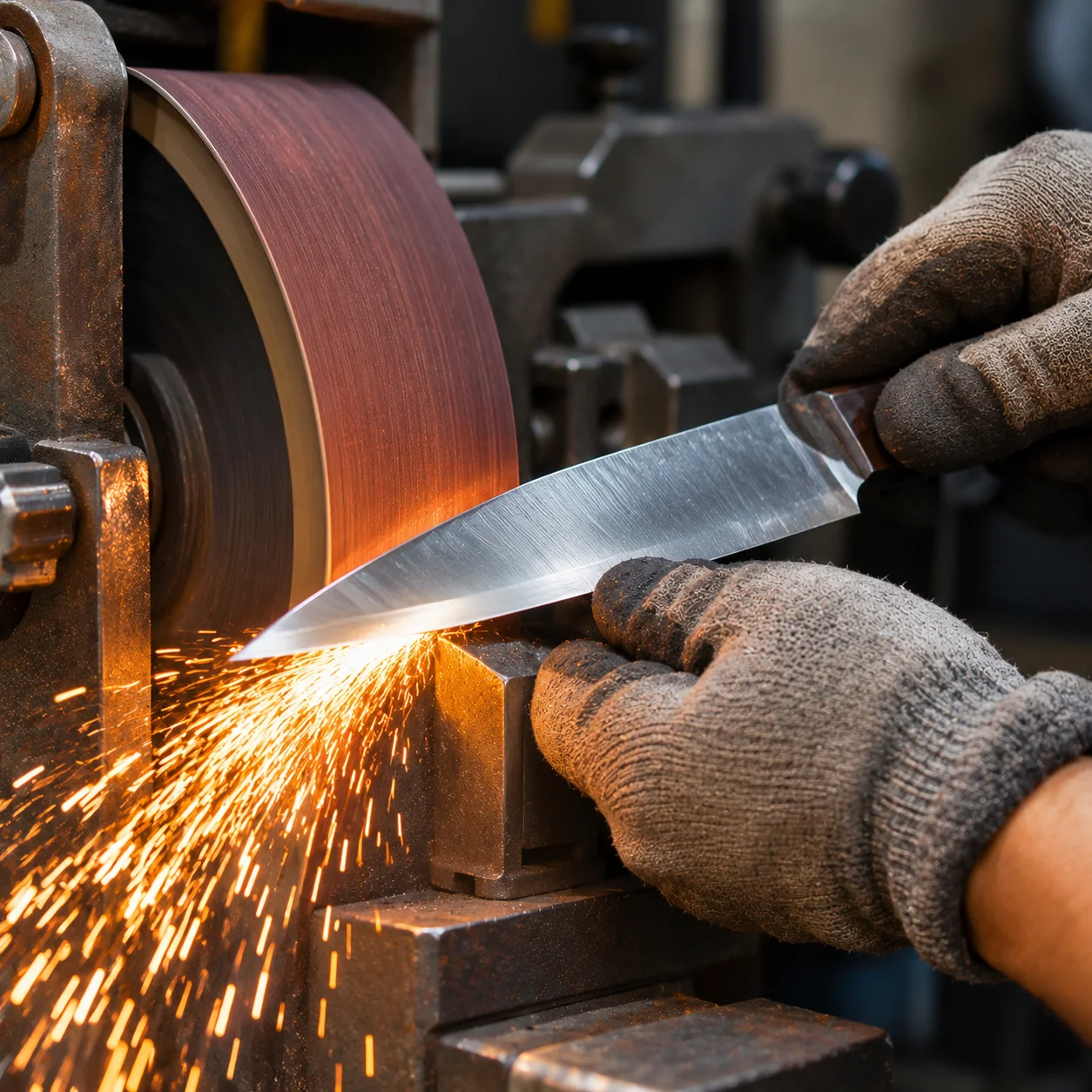
Ask someone to hold a blade at exactly the same angle against a belt or wheel all day and you're asking a lot. The angle and pressure they manage at eight in the morning can drift by four in the afternoon. Even half a degree along a long edge can change how the blade cuts and wears.
Heat causes a different kind of trouble because the damage isn't always visible. If a hardened steel edge gets too hot, it can lose the temper that gives it its hardness. A straw or blue tint may appear at first, then disappear during the next grinding or polishing pass. What's left can look perfectly sound, even though the edge has gone soft.
Not every mistake happens while the blade is against the wheel. Sometimes the wheel hasn't been dressed after a changeover. Sometimes the wrong grit is fitted, or the fixture offset still belongs to the last job. None of that means the operator was careless. It's easy to miss a step on a busy shift when the setup depends on memory.
Build Material Knowledge Into the Process
The steel matters just as much as the grinding setup. A high-carbon steel such as 1095, with roughly 0.95% carbon and hardness in the upper 50s on the Rockwell C scale, holds a fine edge but is more sensitive to heat there than a tougher spring steel such as 5160. Some blades also have a hard edge and a softer spine by design, so one feed rate along the whole blade won't always suit both zones. This breakdown of common blade steels and their heat treatment shows how carbon content, hardness ranges and heat treatment differ from one alloy to another. It gives operators something more useful than 'this steel feels different': information they can put into a setup sheet.
That information shouldn't live in one person's head. Put it in the work instruction or CNC programme against the part number. Then the operator can select the blade without having to work out the feed rate again. Wheel speed, depth of cut, coolant flow and spark-out passes can all be matched to the material instead of being set differently from one shift to the next.
Mistake-Proof the Setup Before the First Pass
The easiest setup mistake to deal with is the one the equipment won't let you make. That's the thinking behind poka-yoke, or mistake-proofing. The American Society for Quality's definition covers ways to prevent errors or make them obvious as soon as they happen. In a grinding cell, that could mean a keyed adapter that accepts only the correct wheel family, a barcode scan that loads the right programme and blocks the wrong one, or an interlock that requires a dressing cycle after every wheel change. Even a fixture that lets the blade fit only one way can stop a left-hand bevel being ground on a right-hand part.
Wheel mounting deserves the same care. The Health and Safety Executive's guidance on the safe use of abrasive wheels explains why correct mounting, inspection and training matter for safety. They're important for finish quality too. A wheel that's mounted badly or out of balance can leave chatter marks and uneven bevels well before it becomes an obvious hazard.
Measure the Edge Instead of Trusting the Eye
A blade can look right and still be outside tolerance. That's where measurement helps. Laser and vision-based profilers can check the bevel angle and edge width along a blade in seconds. Spindle power monitoring can also give an early warning of grinding burn. If the load rises sharply, heat may be building faster than the coolant can take it away.
For hardened carbon steel, regular temper etch checks can pick up overheating that hardness testing may miss. The method in ISO 14104 was developed for gears, shafts and bearings and excludes stainless steel, but the principle can also help with high-carbon blades. Take samples regularly, etch them, and treat any localised discolouration as a reason to check the process, not just reject one blade. Plot edge-angle readings on a simple control chart, and you can spot drift before parts start falling outside tolerance.
Where Automation Fits, and Where It Does Not
Staffing pressure is one reason more factories are looking at automation. According to the International Federation of Robotics, the number of industrial robots working in factories worldwide reached a record five million units in 2025, with annual installations up 11% on the year before. The skills problem also comes through in a survey of 300 machine builders across Europe and North America, carried out for Eaton by S&P Global Market Intelligence 451 Research: 79% said the skills gap was having a significant or very significant impact on their operations.
For blade grinding, the primary bevel is often the best place to start. It's repetitive work with long, steady passes, exactly where fatigue can let the angle creep. CNC grinders and force-controlled robotic cells are well suited to those passes. Final honing, unusual geometries and one-off custom pieces are another matter. Those jobs can still benefit from the judgement of a skilled operator.
There is a catch, though. Put an unstable process on a machine and all you've done is make the same bad blades faster. Before choosing a cell, watch how the operator who gets the most consistent results works. Record the angles, pressures, order of steps and small checks they make almost without thinking. Those details give you a starting point for the programme and a useful training guide for the people still working on the line.
A Practical Starting Point
You don't have to overhaul the whole line to make a difference. Start with the defect that's costing the most: soft edges coming back from customers, uneven bevels that need reworking, or blades scrapped because of burn. Then work backwards to find where the problem begins. Often, the fix is a mix of clearer settings for each material, a setup that prevents the wrong choice and a check that picks up drift early. Skilled hands still matter in blade finishing. They just shouldn't have to make up for a process that leaves so much to memory.
Author Bio:

Owen
Content Partner, Battling Blades
Owen is a content partner at Battling Blades. He contributes content on blade craftsmanship, steelworking and the processes that shape finished blades.
 Our Services
 Media Pack Download
 Newsletters
 Industrial Events