Industrial Metrology Instruments for Smart Factories and Advanced Quality Inspection
Introduction: The Role of Metrology in Modern Manufacturing
The current industrial environment is more dynamic than ever and industrial production is under an increased strain. There is no more quality, precision, and efficiency as an option--quality, precision, and efficiency have become strategic requirements. Industrial metrology, a science of measurement that is used in manufacturing has emerged as a vital facilitator of smart factories and Industry 4.0. The tools that can be used to make sure that the products are of the highest standards, that the processes are efficient, and that the production is in compliance with the compliance and innovation objectives are the industrial metrology tools and systems.
The smart manufacturing now revolves around industrial metrology instruments. Companies can have unparalleled quality inspection, cut on waste and fasten the time-to-market by combining precision measurement systems with automated production lines.
What Are Industrial Metrology Instruments?
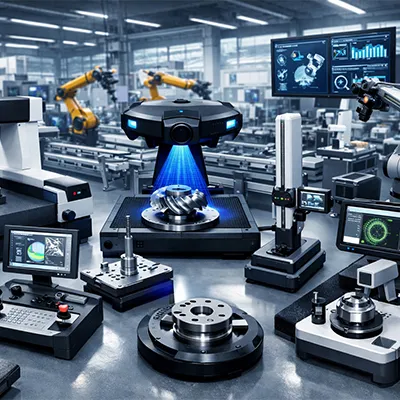
The instrumental devices in industrial metrology are used in the manufacturing conditions to measure physical quantities of dimensions, geometry, surface roughness, temperature and pressure. Such tools include simple calipers and micrometers up to more advanced tools such as 3D scanners and coordinate measuring machines (CMMs).
Definition: Precision Measurement Instruments
Precision measurement tools are instruments that give very accurate measurements that are repeatable, usually within microns, of industrial parts. These tools are necessary to sustain product quality and also to make sure that manufacturing processes are of strict specifications.
Industrial metrology systems are systems of measurement that integrate various measurement tools, sensors and software to provide automated and real-time inspection, the foundation of smart factory quality inspection based on industrial metrology.
Evolution of Industrial Metrology in Smart Factories
Smart manufacturing metrology is also a concept, which has been developed in line with Industry 4.0 efforts. Conventional metrology was much manualized and this was time consuming and subject to mistakes by the human factor. Nevertheless, contemporary factories, however, combine industrial metrology tools of smart factories to enable real-time monitoring and automated feedback loops to boost production efficiency.
| Era | Metrology Focus | Key Tools |
| Pre-Industry 3.0 | Manual inspection | Calipers, micrometers |
| Industry 3.0 | Automated but offline | Coordinate Measuring Machines, laser scanners |
| Industry 4.0 | Smart factory metrology | IoT-enabled sensors, AI-driven inspection, precision measurement systems |
The transformation to offline control to built-in systems of metrology is helping the manufacturers to decrease scrap, enhance steadiness and forecast quality management.
Core Components of Industrial Metrology Systems
Smart factories are typically industrial metrology systems that are made up of three primary parts:
- Measurement Instruments – CMMs, laser scanners, optical comparators and profilometers are devices that record accurate data on components. These are classified as accuracy measurement tools.
- Data Acquisition & Processing Systems – Measuring, deviation-analyzing, actionable software platforms. In the modern systems, AI and machine learning are commonly applied to predict defects.
- Integration with Manufacturing Execution Systems (MES) – By connecting metrology data into the production systems, this allows them to be closed-loop manufacturing so the real-time adjustments keep production to the expected levels.
Advantages of Smart Manufacturing Metrology
Several advantages exist to using metrology tools on the smart factories:
- Enhanced Accuracy: Removes variations and makes components to fit the exact specifications.
- Time Efficiency: Automated checks are quicker than the manual check.
- Predictive Maintenance: The sensors identify wear and tear on equipment’s before they fail.
- Data-Driven Insights: Continuous improvement is made by means of real-time analytics.
- Regulatory Compliance: It has precision measure systems that make sure that it adheres to ISO and industry standards.
Through the development of cutting-edge quality inspection solutions, the manufacturers are able to synchronize operations in accordance with lean and Six Sigma approaches in achieving the greatest output with the least amount of defects.
Applications of Industrial Metrology in Smart Factories
1. Automotive Manufacturing
In the car manufacturing, all the parts, including the engine parts and chassis frames, should be on a strict tolerance. These components can be checked in real-time using industrial metrology equipment, which makes it possible to manufacture a large number of products without affecting quality. Industry 4.0 industrial manufacturing involves precision measurements that guarantee regularity in thousands of units per day.
2. Aerospace
The aerospace components require the micron-level accuracy because of the safety standards. The smart factory is dependent on sophisticated metrology systems to check quality, such as 3D laser scanners, optical comparators, etc. Smart factories check tolerances and surface finishes.
3. Electronics and Semiconductors
In the case of electronics manufacturing, the industrial metrology systems are used to check the dimensions of PCB, quality of soldering and placement of components. The anomalies are identified immediately by smart inspection systems and minimize the expensive production errors.
4. Medical Device Manufacturing
The medical devices need traceable precision. Smart factory Industrial metrology devices will help to adhere to the regulations of ISO 13485 and provide a high-quality manufacturing production of implants, surgical equipment, and diagnostic devices.
Implementing Industrial Metrology Systems: Step-by-Step
The following steps are in place to have a successful metrology implementation in a smart factory:
Step 1: Assessment of Measurement Requirements
Decide on what critical dimensions, tolerances and performance parameters to be checked.
Step 2: Instrument Selection
Select appropriate industrial metrology devices depending on the accuracy, speed and integration.
Step 3: System Integration
Install measurement tools to MES and production lines to facilitate real time feedback of data.
Step 4: Calibration and Validation
The instruments must be standardized on a regular basis to ensure they are accurate and stable.
Step 5: Data Analysis and Reporting
Reduce anomalies and build measurements using advanced programs.
Step 6: Continuous Improvement
Use information on metrology data in order to optimize production methods and reduce defects.
Glossary of Key Terms
- Industrial Metrology Instruments: Instructors used in the measurement of dimensions, geometries, and other physical parameters in manufacturing.
- Precision Measurement Instruments: Precision Instruments that give high-precision measurements are common in the critical manufacturing applications.
- Smart Manufacturing Metrology: Auto-coding of measurement systems into data-driven production environments.
- Advanced Quality Inspection Solutions: End-to-end systems of detecting defects that incorporate measurement equipment, software, and analytics.
- Industry 4.0 Manufacturing: The recent production paradigm of concentration on automation, exchange of information and smart systems.
Frequently Asked Questions (FAQs)
Q1: What distinguishes smart factory metrology from traditional inspection?
Smart factory metrology combines measurement tools with automated systems and real time data analytics, unlike traditional inspection that is based on manual or offline inspection.
Q2: Are precision measurement systems expensive to implement?
Although it may be costly in the short term, it will pay itself off with lower defect rates, increased speed, and predictive maintenance.
Q3: Can these systems be integrated into existing factories?
Yes, the contemporary industrial metrology has a modular nature and can be fitted to already existing production lines with relatively little disturbance.
Q4: How do metrology instruments improve compliance?
These devices allow manufacturers to maintain the appropriate product standards and regulation through giving precise and verifiable measurements of the products.
Choosing the Right Industrial Metrology Instruments
The appropriate choice of the industrial metrology tools to be used in smart factories relies on a number of factors:
| Factor | Consideration |
| Accuracy | Tolerance requirements and measurement resolution |
| Speed | Cycle time compatibility with production line |
| Integration | Ability to connect with MES, IoT, and AI systems |
| Flexibility | Ability to measure different parts and materials |
| Maintenance | Calibration intervals, service requirements, and reliability |
In relation to Industry 4.0 manufacturing, we are talking about the interdependent machines, which are able to capture and analyze the received data in real-time and apply AI to receive predictive information.
Future Trends in Smart Factory Metrology
Industrial metrology is very much associated with Industry 4.0 in the future. Key trends include:
- IoT-Enabled Instruments: Machines carry sensors that record real time information towards central analysis systems.
- AI-Driven Quality Inspection: AI anticipates defects prior to their materialization, which allows making proactive changes.
- Digital Twins: Production line virtual models produce results based on real time metrology data.
- Cloud-Based Analytics: Enterprise-wide insights are stored and analyzed in the cloud with measurement data.
- Robotics Integration: Automated inspection robots are more efficient in doing complicated measurements than humans.
With these trends being implemented in factories, the functions of the sophisticated metrology solutions used in quality checks will become not search and easy measurement but smarter decision-making.
Conclusion
The age of smart manufacturing is the one where industrial metrology tools and systems are no longer an option. They are the basis of intelligent quality inspection of factory using industrial metrology to guarantee that the production processes are accurate, dependable as well as compliant. Following the use of precision measurement systems to manufacture Industry 4.0, businesses will be able to be more efficient, minimize defects, and make their decisions based on the data.
In automotive, aerospace, electronics, and medical manufacturing, the incorporation of industrial metrology tools in smart factories can be seen as a strategic investment that leads to quality, productivity and innovativeness. The future will be in the individuals who measure as well as utilize the understanding of measurements to generate intelligent and more responsive factories.
 Our Services
 Media Pack Download
 Newsletters
 Industrial Events