How AI and IT Services Are Redefining Plant Automation Technology in 2026
Industrial plants in 2026 look nothing like production sites from just a few years ago. Equipment commissioning that once took weeks now happens in hours. Lines that previously stopped every month for maintenance now operate continuously for entire quarters. Even veteran engineers admit their roles have fundamentally changed.
The force behind this transformation is intelligent automation—AI systems combined with edge computing and cloud platforms now manage tasks that weren’t even discussed five years ago. Predicting equipment failures, dynamically adjusting material flows, optimizing energy consumption in real time—these capabilities have moved from experimental pilots to standard operational practice across food processing, pharmaceuticals, chemicals, electronics, and heavy manufacturing.
Plant automation is no longer about isolated machines. It’s about orchestrating entire facilities as unified digital systems.
From Central Servers to Edge and Cloud
Traditional factories depended on on-site server rooms to handle production data. That model fails when thousands of sensors generate massive data streams and decisions must be made within milliseconds.
Today’s plants rely on hybrid architectures. Time-critical processing happens locally at the edge, directly beside production equipment, while cloud platforms handle analytics, model training, and long-term optimization. This allows factories to stay operational even during network disruptions while continuously improving performance through cloud-based intelligence.
Large technology providers now play a central role in enabling this shift by bringing enterprise cloud, AI, and edge platforms directly into industrial environments. Modern manufacturing IT services — like those delivered by DXC Technology—focus on integrating production systems with scalable digital infrastructure, advanced analytics, and AI-driven operations across complex factory environments.
Although many early implementations came from automotive programs, the same architectural principles—edge analytics, cloud scalability, and data-driven process optimization—are now widely adopted across plant automation in food processing, pharmaceuticals, chemicals, electronics, and heavy industry.
This setup is especially critical for continuous-process facilities, where even brief latency or connectivity issues can immediately translate into quality losses or production downtime.
Scaling Without Heavy Capital Investment
Cloud infrastructure has quietly rewritten the economics of plant expansion. Increasing production capacity no longer requires purchasing and installing new servers. Instead, computing resources scale on demand.
This flexibility matters most in multiproduct facilities. Lines that switch between formulations or product variants can automatically load the appropriate AI models and parameters from the cloud. Production volumes rise or fall in days rather than months, while IT infrastructure adapts invisibly in the background.
Predictive Maintenance Becomes the Default
Maintenance used to follow fixed schedules. Equipment was serviced because calendars said so, not because machines actually needed attention. That approach led to unnecessary downtime and premature part replacement—while some failures still arrived unexpectedly.
AI-driven predictive maintenance changes this logic entirely. Machine-learning models analyze vibration patterns, temperature trends, power consumption, and acoustic signals to understand how healthy equipment behaves. Subtle deviations reveal wear weeks before breakdowns occur.
In industries where a single unexpected failure can cost millions, this shift alone often pays for the entire automation program within a year. These systems don’t remain static either. They continuously retrain themselves using new operational data, becoming more accurate over time.
Intelligent Material Flow Inside the Factory
Material logistics has also evolved. Instead of fixed delivery intervals, modern plants track consumption in real time. When production speeds up, components arrive more frequently. When lines slow, deliveries automatically decrease. Excess buffers disappear, and shortages are prevented before operators even notice a problem.
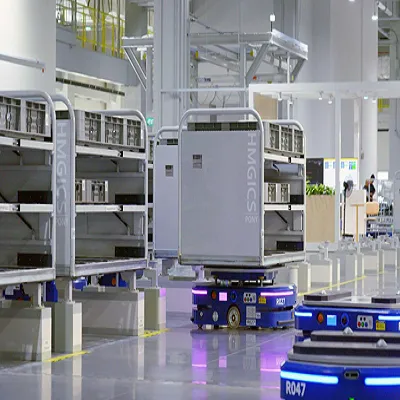
This logic connects directly with MES, ERP, and warehouse systems, creating closed-loop internal supply chains. Autonomous vehicles, workstation sensors, and AI forecasting now coordinate material movement with minimal human intervention, turning factories into self-regulating environments.
Quality Control Without Fatigue
Human inspectors inevitably miss defects after hours of repetitive work. Computer vision systems don’t.
Cameras now examine every product with consistent precision, identifying surface flaws, geometric deviations, structural defects, and assembly errors at full production speed. In electronics and pharmaceuticals especially, AI inspection routinely outperforms manual checks, catching imperfections invisible to the naked eye.
Building these systems starts with massive image datasets of good and defective products. Once trained, models classify defects by severity and automatically route items for rework, downgrade, or scrap—making quality control a continuous, automated process rather than a final checkpoint.
Energy Optimization and Carbon Visibility
Large manufacturing sites consume energy on the scale of small cities. AI-based energy management platforms now optimize usage minute by minute, aligning production schedules with energy availability, smoothing peak loads, and integrating renewable sources.
At the same time, carbon accounting has become granular. Instead of rough quarterly estimates, plants calculate emissions continuously, factoring in electricity sources, process intensity, material transport, and waste handling. Individual batches—and sometimes individual products—receive digital carbon footprints, turning sustainability into an operational metric rather than a reporting exercise.
Digital Twins and Virtual Operations
Digital twins provide virtual replicas of entire facilities, mirroring machines, material flow, and process logic. Engineers test layout changes, routing strategies, and process adjustments in simulation before touching physical equipment. This dramatically reduces risk and accelerates modernization.
The same virtual environments are used for workforce training. Operators practice procedures and emergency scenarios in immersive simulations, shortening onboarding time while eliminating safety risks associated with learning on live production lines.
Connected Plants Demand Stronger Security
With tens of thousands of connected devices, cybersecurity has become a core part of plant automation. Modern factories isolate production networks, apply AI-based anomaly detection to traffic patterns, authenticate devices cryptographically, and monitor access continuously. Security is no longer an IT afterthought—it’s embedded directly into automation architecture.
Humans and Machines Working Together
Robots are no longer confined behind safety cages. Collaborative robots now operate alongside people, handling repetitive or heavy tasks while humans focus on problem-solving and quality decisions. These deployments typically don’t eliminate jobs; instead, they shift workers toward higher-value roles in supervision, optimization, and setup.
Programming has also become simpler. Operators teach robots by guiding movements physically and refining logic through visual interfaces, enabling rapid reconfiguration without writing code.
The Reality Check
Despite rapid progress, plant automation still faces real obstacles. Legacy equipment produces messy data. Control systems from different eras resist integration. Engineering teams must acquire new skills, and upfront investments remain significant.
Equally challenging is the human factor. Experienced staff often distrust algorithm-driven recommendations at first. Successful projects usually rely on pilot deployments that demonstrate measurable improvements, allowing performance data to overcome skepticism.
Looking Ahead
Over the next few years, generative AI will begin assisting process and component design, autonomous internal warehouses will become common, private 5G networks will enable ultra-low-latency control, and early quantum optimization experiments will target scheduling and logistics.
Plant automation powered by AI and IT services is no longer a future concept—it’s operational reality in 2026. Factories that move quickly gain advantages in efficiency, quality, sustainability, and resilience. Those that hesitate risk falling behind as intelligent automation reshapes manufacturing at remarkable speed.
 Our Services
 Media Pack Download
 Newsletters
 Industrial Events