Trucks and Heavy Vehicles in Industrial Automation: Technologies, Applications and Smart Fleet Solutions
Introduction
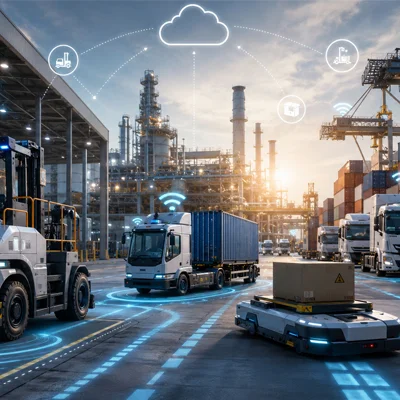
Industrial operations across manufacturing, logistics, mining, and warehousing are undergoing a quiet but profound transformation. At the center of this shift are trucks and heavy vehicles in industrial automation applications — machines that were once purely mechanical workhorses and are now becoming intelligent, connected, and increasingly autonomous. As factories and distribution centers race to improve throughput, safety, and cost efficiency, heavy vehicles for industrial automation have moved from the periphery of digital transformation to its very core.
This article explores the technologies powering this change, the practical applications reshaping industrial operations, and the smart fleet solutions that are helping organizations extract maximum value from their vehicle assets.
The Shift toward Automated Heavy Vehicles
For decades, heavy vehicles used in industrial settings — forklifts, yard trucks, haul trucks, tow tractors, and delivery fleets — operated largely on manual control with minimal data feedback. Operators made decisions based on experience, radios, and paper logs. This approach worked, but it left significant inefficiencies on the table: idle time, suboptimal routing, unplanned maintenance downtime, and safety risks from human error.
Automated heavy vehicle technologies for modern industrial operations have emerged to close these gaps. By combining sensors, onboard computing, wireless connectivity, and advanced software, today's industrial vehicles can perceive their environment, communicate with central systems, and in many cases, operate with little or no human intervention. This shift is not simply about replacing drivers — it's about creating a continuous flow of data and decision-making that makes entire operations smarter.
Core Technologies Driving Industrial Truck Automation
Sensor Fusion and Perception Systems
Modern industrial truck automation systems rely on a combination of LiDAR, radar, ultrasonic sensors, and high-resolution cameras to build a real-time map of a vehicle's surroundings. This sensor fusion allows heavy vehicles to detect obstacles, pedestrians, other equipment, and infrastructure changes, enabling safe navigation in dynamic environments like warehouses, ports, and construction sites.
Onboard Computing and AI
Edge computing units process sensor data locally, allowing vehicles to make split-second decisions without relying solely on cloud connectivity. Machine learning models trained on vast datasets help these systems recognize patterns, predict potential hazards, and optimize paths in real time. This is a critical enabler of autonomous industrial vehicles, which must operate reliably in environments shared with human workers.
Connectivity and IoT Integration
Perhaps the most transformative element is connectivity. Connected fleet management technologies link every vehicle to a central network, streaming data on location, speed, fuel or battery levels, engine diagnostics, and cargo status. This constant data exchange forms the backbone of modern fleet visibility, allowing operations managers to see their entire vehicle ecosystem on a single dashboard rather than relying on fragmented, delayed reports.
GPS and Precision Positioning
Accurate positioning — often enhanced with RTK (Real-Time Kinematic) GPS for centimeter-level precision — is essential for automated navigation, especially in outdoor industrial environments like mining sites or large distribution yards where vehicles must follow exact paths repeatedly.
Vehicle-to-Everything (V2X) Communication
V2X technology allows heavy vehicles to communicate not just with a central system but with each other and with infrastructure such as loading docks, traffic signals, and gates. This reduces collisions, improves coordination between multiple autonomous units, and streamlines complex operations like container yard management.
Fleet Management Systems: The Operational Backbone
While individual vehicle intelligence is important, the real value emerges when it's aggregated and orchestrated. Fleet Management Systems (FMS) serve as the operational backbone that ties together data from every truck, forklift, and heavy vehicle in an organization's fleet.
A modern FMS typically provides:
- Real-time tracking of vehicle location, status, and utilization
- Predictive maintenance alerts based on engine diagnostics and usage patterns
- Route and task optimization to reduce idle time and fuel consumption
- Driver and operator performance monitoring for safety compliance
- Automated reporting and analytics for operational decision-making
These systems have evolved from simple GPS trackers into comprehensive platforms that integrate with enterprise resource planning (ERP) and warehouse management systems (WMS). This integration means that a delay in one part of the supply chain — say, a shipment arriving late — can automatically trigger rerouting of trucks or reprioritization of tasks without manual intervention.

Autonomous Industrial Vehicles in Practice
Autonomous industrial vehicles are no longer experimental novelties confined to pilot programs; they are increasingly standard equipment in specific use cases:
Automated Guided Vehicles (AGVs) and Autonomous Mobile Robots (AMRs) move materials within warehouses and factories along predefined or dynamically calculated paths, reducing the need for manual forklift operation in repetitive, high-volume tasks.
Autonomous yard trucks shuttle trailers between docks and staging areas in distribution centers, operating around the clock without fatigue-related risks.
Driverless haul trucks in mining and quarrying operations transport materials across large, controlled sites, dramatically improving safety by removing operators from hazardous zones.
Autonomous delivery and yard tractors at ports and intermodal terminals move containers with precision, reducing congestion and turnaround times.
Each of these applications illustrates how heavy vehicles for industrial automation are tailored to specific operational contexts, balancing the level of autonomy with the complexity and unpredictability of the environment.
Smart Fleet Solutions for Manufacturing
Manufacturing environments present unique challenges: tight production schedules, just-in-time inventory requirements, and the need for seamless coordination between machines, materials, and people. Smart fleet solutions for manufacturing address these challenges by embedding vehicle automation directly into production workflows.
For example, automated tow tractors can deliver components to assembly lines exactly when needed, synchronized with production schedules via real-time data feeds. If a production line's pace changes, the fleet management software automatically adjusts delivery timing and vehicle allocation. This reduces the buffer inventory traditionally needed to prevent line stoppages, freeing up floor space and capital.
Smart fleet solutions also enable predictive analytics that flag potential equipment failures before they cause downtime. By analyzing vibration patterns, temperature fluctuations, and usage history, these systems can schedule maintenance during planned downtime rather than reacting to breakdowns — a shift from reactive to proactive operations management.
Smart Fleet Solutions for Industrial Logistics and Manufacturing
Beyond the factory floor, smart fleet solutions for industrial logistics and manufacturing extend automation benefits across the broader supply chain. Distribution centers, cross-docking facilities, and transportation networks all benefit from the same principles of connectivity and intelligent orchestration.
Key applications include:
- Dynamic route optimization that accounts for traffic, weather, and delivery priorities in real time
- Load optimization algorithms that maximize cargo efficiency while respecting weight and safety limits
- Cross-facility coordination where trucks moving between plants, warehouses, and ports are tracked and managed under a unified system
- Energy management for electric and hybrid heavy vehicles, ensuring charging schedules align with operational demands
This holistic approach ensures that automation isn't siloed within individual facilities but extends across the entire value chain, creating compounding efficiency gains.
Benefits and Business Impact
Organizations adopting these technologies report improvements across several dimensions:
Safety — Automated systems reduce human error, a leading cause of workplace incidents involving heavy vehicles. Collision avoidance systems, automated braking, and geofencing capabilities all contribute to safer operations.
Operational efficiency — Optimized routing, reduced idle time, and better task allocation translate directly into higher throughput and lower operating costs.
Reduced downtime — Predictive maintenance, enabled by continuous vehicle monitoring, minimizes unplanned outages that can halt entire production lines.
Labor optimization — While automation changes workforce requirements, it also allows human workers to be redeployed to higher-value tasks that require judgment and adaptability, rather than repetitive vehicle operation.
Data-driven decision-making — With comprehensive visibility into fleet performance, managers can make informed decisions about capital investment, resource allocation, and process improvements.
Challenges and Considerations
Despite the clear benefits, organizations face real challenges in adopting these technologies. Initial capital investment can be substantial, particularly for retrofitting existing fleets or building new autonomous vehicle infrastructure. Integration with legacy systems requires careful planning, and cybersecurity becomes increasingly important as vehicles become more connected and data-dependent.
Workforce transition is another critical consideration. Successful automation programs typically involve reskilling initiatives that help existing operators and drivers move into supervisory, maintenance, or systems-management roles rather than simply displacing them.
Regulatory frameworks for autonomous vehicles, particularly those operating in mixed environments with human workers, continue to evolve, requiring organizations to stay current with safety standards and compliance requirements.
Looking Ahead
The trajectory for trucks and heavy vehicles in industrial automation points toward deeper integration, greater autonomy, and more sophisticated fleet intelligence. As artificial intelligence models improve and connectivity infrastructure like 5G becomes more widespread, the responsiveness and reliability of these systems will continue to advance.
Future developments are likely to include greater interoperability between different manufacturers' equipment, more advanced predictive analytics powered by AI, and expanded use of electric and alternative-fuel heavy vehicles integrated into smart fleet ecosystems. The convergence of automation, connectivity, and sustainability goals will shape the next generation of industrial vehicle technology.
Conclusion
The integration of automation into trucks and heavy vehicles represents one of the most significant operational shifts in modern industry. From autonomous industrial vehicles navigating warehouse floors to connected fleet management technologies orchestrating complex logistics networks, these innovations are redefining what's possible in manufacturing and industrial logistics.
Organizations that invest thoughtfully in fleet management systems, industrial truck automation systems, and smart fleet solutions position themselves not just for incremental efficiency gains, but for a fundamental competitive advantage in an increasingly automated industrial landscape. As these technologies mature, the question for most organizations is no longer whether to adopt them, but how quickly and effectively they can do so.
 Our Services
 Media Pack Download
 Newsletters
 Industrial Events