How Can Manufacturers Combine AI, Robotics, and Workflow Automation to Improve Decision-Making?
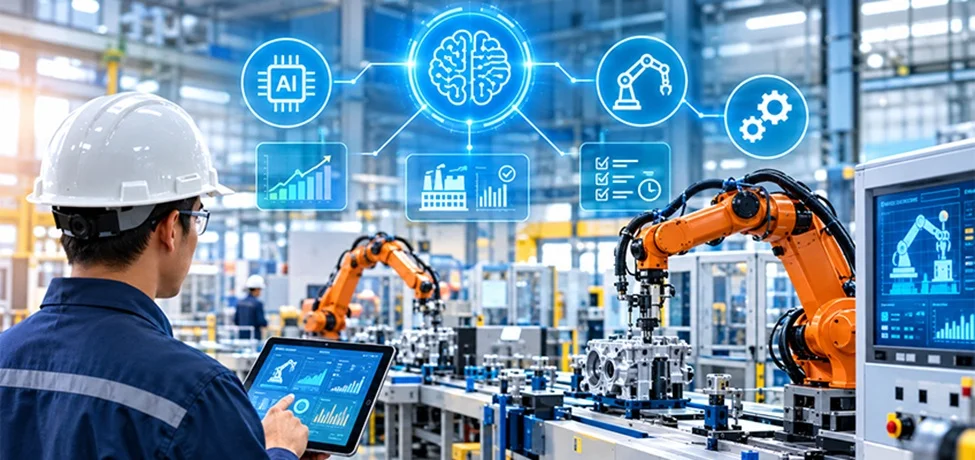
For the CXOs, investing in AI and automation is a very important decision for the manufacturing organization, as far as plant capacity, cost of production, quality of the product, and business growth are concerned.
Deciding which technology should be used to increase output, or reduce downtime or smooth production completely depends on ‘how well the leaders understand these technologies.’
Robotics, AI, and automation individually can affect decision-making power.
AI will compute results and risks using machine and production feed data. While Robotics creates factory plans, automation links maintenance and quality check requests to production planning.
These technologies have gaps if used individually. AI could detect the risk when machines fail, but it might need human intelligence to maintain the machine. Robots might help in boosting the production in manufacturing, but might not detect the bottlenecks. Automation might reduce manual efforts, but only if teams provide non-siloed data.
Manufacturing leaders must know how these technologies work when brought together. They must make appropriate decisions around which technology suits their enterprise. The right investment must solve operational issues, drive improved decision-making, and create business value.
Why Do Manufacturing Decisions Remain Fragmented with Individual Technology Investment?
For manufacturing CXOs, the investments in AI, robotics, and workflow automation need to do more than improve the performance of their part of the business.
They should be able to manage costs for quality and increase plant capacity and avoid downtime, and protect margins.
But when these technologies are working in silos, it creates disconnection in decisions across the plant.
AI without connected action: AI is able to forecast that a piece of critical equipment is about to fail, but if that maintenance isn't prioritized over the demand of production, then the plant could lose a couple of hours of production.
Now, management fails to quantify the losses due to downtime. Not just this, leaders also can't and confirm delivery commitments.
Robotics without coordination: A robot system might increase assembly capacity by about 30%. But if raw materials run out or the next stage of production is unable to take the extra output, overall throughput may not improve.
CXOs may add capacity, but they may not achieve the revenue/return on capital growth they were seeking.
Automation without production intelligence: Automated workflows may generate reports that include defects and maintenance requests.
But without quality, machine, and material data to use in real time, teams may not know what to resolve first.
The result? Production lines may go into action when they are supposed to be shut down. They might also wait for never-restocked materials. These gaps can create scrap, delay orders, and reduce the effect of investment in the technology.
These challenges are not just about individual systems. NIST’s 2026 Roadmap on Artificial Intelligence and Machine Learning for Smart Manufacturing identifies industrial data complexity, data management and integration across different sensing and control systems as key barriers to reliable AI deployment.
For CXOs, the priority is to assess how these technologies can work together. They can improve how teams prioritize maintenance, schedule production, defect response and material availability. The goal is to make better-connected decisions that improve plant performance and deliver measurable business returns.
(The figures in these examples are illustrative, not verified industry benchmarks.)
What Happens Exactly When Manufacturing Leaders Make Decisions Using a Combined Approach?
Combining AI, Robotics, and Workflow Automation gives a clear benefit. Leaders gain the ability to act on critical business decisions easily. They now stop relying on improving one task at a time. Because the combined approach helps them connect production data, operational analysis, and execution to focus on wider business priorities.
|
Decision-making stage |
What the combination method enables |
CXO Influence from Manufacturing Outlook |
|
Risk identification |
AI detects potential equipment breakdowns and quality issues. |
COO: Can identify risks in production and delivery. |
|
Act First |
Workflows enable alerts and tasks to be sent based on production requirements. |
Maintenance Lead/COO: Can formulate priorities in maintenance to reduce idle time. |
|
Precautions |
Robots handle suitable physical tasks, while people manage exceptions. |
COO: Will be able to measure improvements in capacity and the required staff to augment. |
|
Adjusting production |
And machine data, quality, and inventory enable teams to react to changing conditions. |
Crisis Manager / COO: Can react faster to bottlenecks and shortages of materials. |
|
Outcome measurement |
Automation in measuring production, quality, cost, and downtime. |
CFO/CEO: Can see positive return on investment and where to invest more. |
How Do AI+ Robotics+ Workflow Automation Improve Manufacturing Decisions?
Each technology helps to take the 'right' next step in a manufacturing process.
Consider a production line where machine data points to a possible equipment fault. Here is how the three technologies can help teams respond.
AI identifies the risk and its potential impact.
AI is able to identify abnormal patterns in the production (history, manufacturing information, machine output) that may indicate a defect. Allow teams to assess the risk and urgency of acting on an issue.
What should leaders do?: Faults should be communicated to the maintenance teams, and output and delivery dates to the production leads.
Robotics supports the physical response.
It can focus on material handling/transfer/moving or inspection. This helps teams with manual work as they diagnose faults or recalibrate output.
Tip for leaders: In enterprises, attribute judgment and accomplishments to robots. If you're bottlenecked on producing, then adding robots won't increase capacity.
Workflow automation coordinates the response.
Production & maintenance planners are notified, and affected assignments are approved, if necessary, through an automated workflow. It may also alert them to review the production schedule where the fault will delay an order.
Machine alerts should not dictate workflows; business priorities should. Equipment that has a spare might not need as much attention as a critical production line may demand.
Feedback helps teams decide what to do next.
Teams can see the problem is solved through altered readings and production from the machines once it is resolved. They can then resume to start production again or adjust schedule or further analyze.
In theory, every decision using these technologies seems perfect. But behind it, there lies good data, clear clues for escalations, and human supervision. If teams implement this integrated approach correctly, it positively impacts decisions related to production, costs, and delivery.
Where Can Manufacturers Use this Integrated Approach?
1. Deciding Which Assets Should Receive Maintenance Investment?
With machine data and maintenance history, AI can show possibilities of machine failure. Teams can link these results to maintenance plans and production schedules through workflow automation. This helps robotics transport materials for maintenance or make adjustments for production.
This helps CXOs to understand what assets need immediate attention. They also know where preventive maintenance can help reduce production losses. They can also decide whether to repair or to upgrade the equipment.
Practical advice: Check and rank assets based on cost of downtime, impact on production, history of failure, and availability of backup. Connect machine alerts with maintenance and production planning.
Also check: Unplanned downtime, maintenance costs, and how the assets are used.
2. Where Should the Manufacturers Invest to Reduce Quality Costs?
AI identifies patterns using inspection results and production data. To automate inspection and product handling, teams can use robotics. What workflow automation does is to track affected batches. It sends the quality alerts to teams for corrective actions.
This helps leaders make the decision: whether to invest in improved inspection systems or whether the manufacturing system needs more automation to reduce customer scrap, rework, and returns.
What manufacturers must do: Check and identify product lines with too high defect percentages or quality costs. Understand if the updated inspection methods and corrective actions can find the root causes.
How to measure results: Check what poor production quality costs, and find rework costs, defect rates and customer returns.
3. Should the Business Expand Production Capacity or Improve Existing Operations?
Artificial intelligence analyzes the current demand for production. It checks whether the enterprise has enough capacity or not. It also finds the exact issues in the output. This helps leaders to understand where exactly the output is compromised.
Workflow automation balances the needs of production and the availability of materials. Robots perform suitable repetitive jobs and material handling.
This allows CXOs to take a call on whether to invest in more robotic systems or optimize the flow of production or better utilize existing assets. The decision should consider the entire production process. Not just the capacity of one machine.
How Does It Look in Reality?
A real-world example is Coca-Cola’s Tuas Bay manufacturing site in Singapore.(World Economic Forum’s Global Lighthouse Network 2025 report)
Coca-Cola combined machine learning, robotics, and production-scheduling algorithms for demand forecasting. They saw a 28% increase in throughput.
Shortages were reduced by 80% and a 31% improvement in on-time delivery. These results reflect the wider transformation, rather than the contribution of any single technology.
What Manufacturers Must Do: Compare the cost of new equipment vs. the benefits of solving problems and capacity. Calculate the costs related to operations and production. Compare them to the increase in expected productivity level.
Check the results with: Throughput, output per shift, production cost per unit, and ROI.
4. How Can Businesses Control Business Inventory Costs and Delivery Promises?
Create AI to assess supply/materials and production. For example, what shortages could be derived from the supply. Create robots that act as helpers to transfer materials. Workflow automation also manages post-escalations and replenishment requests.
This lets CXOs receive pricing tactics, production schedules, purchase priorities, or product-mix shift priorities in time to protect customer shipments without tying up excess working capital.
What manufacturers can do: Identify materials that tend to cause stoppages or excess stock. Connect inventory to what production actually needs. Create rules for handling supply risks.
Check results: Measure stock turnover, inventory turnover, and delivery time.
Where Should Leaders Start Investing
Focus on the decisions that impact cost, capacity, quality, or delivery of manufacturing. Set a baseline. Review data and integration requirements. Test the approach against specific business targets before actual implementation.
What Factors Should Manufacturers Consider When Choosing the Right Automation Partner?
Not every automation partner considers the factors of capacity, downtime, quality, and operating cost.
The right partner understands the trade-offs between these factors. It then shows how to reduce those trade-offs by combining AI, robotics and workflow automation.
You can relate the features of RPA services to the overall integration and automation of workflow if you are in line with RPA services.
A Tech Combination That Improves Decisions
Whether the leader chooses AI or automates workflows, or simply selects robotics, every technology will only help manufacturing, production, and business growth decisions. But if they want to create a bigger impact, a combined approach is itself a great decision.
Leading businesses are already linking these technologies for better decisions. The choice for leaders is clear: either prepare for testing individual technologies or invest in the combined approach to improve decision-making.
 Our Services
 Media Pack Download
 Newsletters
 Industrial Events